Following a Trail
(Alert: this is probably one of the more important things I’ve written.)
It’s fun when you start on one journey in reading, and that path leads to unexpected places. That’s what happened last week while I was reading a book by Mark Nepo called Finding Inner Courage. In passing, he mentioned a quotation of Cicero, usually tagged, “Six mistakes mankind keeps making century after century.” It resonated with me, and I thought it deserved to be resurrected and examined more than just in passing.

Marcus Tullius Cicero was born in 106 B.C.E., and was killed by forces in league with Mark Antony in 43 B.C.E., having been named an enemy of the State for writing diatribes against the Second Triumverate in favor of a return to a republic. He was a politician, but his most lasting reputation was that of an orator who affected writers after him for hundreds of years, most notably Petrarch. Others who trod his path were Hume, Locke, Montesque, and probably Thomas Jefferson. One historian wrote that the Renaissance was actually a revival of Cicero, and through him, classical antiquity. We could certainly use him today.
Our first recurring mistake according to Cicero: Believing that personal gain is made by crushing others.
The backstory to this error is the pie theory – if you get a bigger piece of pie, mine will be smaller. The error in this picture is its assumption that the pie doesn’t get bigger, that a Gross National Product never increases, that production doesn’t improve, that new products aren’t developed and greater efficiency never happens. In short, this mistake assumes there is never enough of anything – food, capital, knowledge, stuff. Even with recessions every 25 years or so, data and Warren Buffet contradict this view. Ten years ago we suffered through one of our worst recessions ever, but now the market is up to over 18,000, unemployment is down, and we’re producing more of everything from cars to cell phones. We’re almost back to where we were, and in some ways, we’re better off than then.
There is a corollary mistake, it seems to me. I don’t care how many assets the top 1% of our wealthy accumulate. Each one can have ten mansions and 43 Rolls Royces for all I care. What does bother me are two related things. When they use their money and its power through governments to crush or take advantage of others, I have a problem. Don’t tell me it isn’t happening. It doesn’t bother me if people rise to the top on a level playing field, but that’s not what we have.
The second thing is that all humans, I truly believe, deserve a minimum of safety, housing, food, and health care. We can afford that and don’t need to take away anyone’s mansion. We can’t accept starvation and needless death, especially of innocent children. How we treat our weakest, our infirm, our mentally challenged, and our veterans suffering from PTSD for our sake, is a greater test of who we are than how much affluence is evident in our society. I want some enlightened capitalism. For example, I saw an article in a local Madison paper last week with the headline: More Than Minimum. It noted that one of the independently-owned Culver’s fast food restaurants in Madison paid workers four to eight dollars over the minimum wage per hour, included health care, dental insurance, two weeks of vacation and a contribution to a 401 K account. The owner, Susan Bulgrin, said it was worth it to keep employees working together in an experienced crew rather than re-training temps every two weeks. Besides, she said “It was just the right thing to do.” I don’t eat much fast food, but the next time I do, I know where I’m going. Bulgrin has it right. Hers is now the top performing Culver’s in Wisconsin. It’s on Todd Drive, just off the Beltline near Park Street and Badger Road in Madison.
Seattle understood the same thing when they figured out if they required a higher minimum wage, those workers would spend more money in the community, and it would help everyone in the long run. The pie grows bigger, including a bigger piece for restaurant owners. Pay workers less and an owner might make more money in the short run, perhaps more than he can spend in the community, but the pie grows smaller and more stores will close, including eventually, that owner’s store. Detroit is a good example. If executives keep their high-paying jobs even in mis-managed companies with bad design decisions based on short-term profit, while the workers’ pay is reduced or their jobs cut, the community will fail.
Our second recurring mistake according to Cicero: Worrying about things that cannot be changed or corrected. This worry does not include the first recurring mistake. We don’t need to crush others. There really isn’t that much that fits into this category. There are some health issues, stage 4 cancer for example, that cannot be immediately be corrected. In the long term, I believe everything can be changed. We’ve already found treatments for cancer that add years, if not a lifetime, to diseases that were short-term death sentences 50 years ago. Do you know anyone with polio? Me neither. Everything else can be corrected or changed. (More on that next time). Even when our education system is under attack, is it better than the one-room schoolhouse of two generations ago? Yes. Is it better than the abuse I and my classmates suffered at the hands of a damaged nun in first grade? Yes. We can start by avoiding another fallacy – speaking of education in the U.S. as if it is one terrible monolithic institution. We have great schools and we have terrible schools. Most of the terrible ones are in ghettos or economically depressed areas. We should ignore the test scores, which are mis-interpreted at best and useless at worst. Here’s a better place to start – look at a recent TED talk about new and more human ways to run a business or a school.
Cicero’s advice here makes much more sense on the personal level. I can’t change the people around me beyond requesting something irksome or offensive be stopped. They may not, and then I may choose to leave. There are things we can change. That’s the basis of the “Serenity Prayer” of AA penned by Reinhold Niebuhr and his daughter –
“God, Give us the grace to accept with serenity
the things that cannot be changed, Courage
to change the things which should be changed,
And the wisdom to distinguish the one from the other.”
This leads me to a subject of another blog at a later time, the fallacy of the “all or nothing” attitude. The short version is that I don’t believe we can solve most of our problems today. What we can do is make things better; keep making them better over the span of months and years, and then the problems go away. It’s the idea for most things we face. Infrastructure – fix one bridge and road at a time. Schools – improve one at a time. Healthcare, hospitals, dangerous mines, unwanted pregnancies, terrorist plots, unsafe neighborhoods? The only way they can be improved (and probably perfectly fixed) is one at a time. It’s the central idea of another thread, a book by Anne Lamott on how to be successful at writing a book on birds (or anything) by writing bird by bird.
The point of what Cicero said is the futility of worry about things we can’t change. We worry about society, politics, children, traffic, and the weather. One irony here is that some of the people I know who worry the most (or are angry – and anger is worry in action) are very religious people. You’d think their faith would give them reassurance that a higher power is in control, but that doesn’t seem to be happening for them. Deep spirituality matters a lot, but adherence to any one particular religious institution – not so much. We all ought to carry a card that we’d pass on to anyone we meet. It would read: I am a human being with spiritual traits. I am currently on Earth – just along for the ride. It’s an interesting vehicle – this little blue planet. I pick up my own trash. Tell me your story. In The Hitchhiker’s Guide to the Universe, it is recommended that we all travel with a towel and don’t panic. I agree.
I also believe and will soon write about the idea that if something is true, its complement is also true. Cicero says this in his next major human mistake: Insisting that a thing is impossible because we cannot accomplish it. History is full of examples of this fallacy.
If you are the politician, engineer, governor, or county road commissioner who believes he can fix every road and bridge in his district – go for it. When I look around, I don’t see it happening. We have had some major surprises, though. People do the seemingly impossible. Ending polio. Sending astronauts to the moon. Dental implants. 3D printers. Smartphones. Solar-powered buildings. Cars that warn of dangers and will soon drive themselves. Sometimes I think the greatest impetus to achieving something remarkable is being told it couldn’t be done. So I’m saying it. I dare anyone out there to prove me wrong. Ha. A cure for pancreatic cancer? Let’s see it. Cicero says you can do it, even though he couldn’t.
Even geniuses could be surprised. If you told Leonardo da Vinci how much a jumbo jet weighed and then said it was about to fly, he would not believe you. Einstein had a hard time believing that over 60% of the energy in the cosmos was in the form of “dark matter” that could not be seen and may perhaps exist only in another dimension that we could not study. He understood the math, but not the enigma. Mere milkmaids cured smallpox, although Edward Jenner got the credit. The “un-doable” is a long list: pyramids, heart surgery, detached retina surgery, memorizing the Bible, Fitbits, GPS devices that can find small trout streams in the middle of Wisconsin coulee country, bionic replacement parts, and even this “olde” iPad and Bluetooth keyboard on which I blog. If I write this blog again a year from now, who knows what could be added to the list in that short time. Cicero is right – we advance technologically and keep making the same six philosophical mistakes over and over again.

Mistake number 4: Refusing to set aside trivial preferences. We all have experienced family feuds, perhaps not the deadly ones between families, but the ones inside a family – Aunt Tillie won’t be in the same room with Uncle Marco because he made some disparaging, not-funny joke about her potato salad in 1987. Okay here’s one… I’m writing this inside the terminal of the Milwaukee airport (that’s another story) at a table next to a wonderful Colectivo Coffee lounge, and three sparrows just hopped by on the carpeting next to me looking for crumbs from my table. I’m used to this at the Terrace of the University of Wisconsin Memorial Union, but inside the terminal? I know people who would be horrified and would move. I think they’re cute, and I don’t plan on moving. Here’s one of my friends on the carpeting next to me.
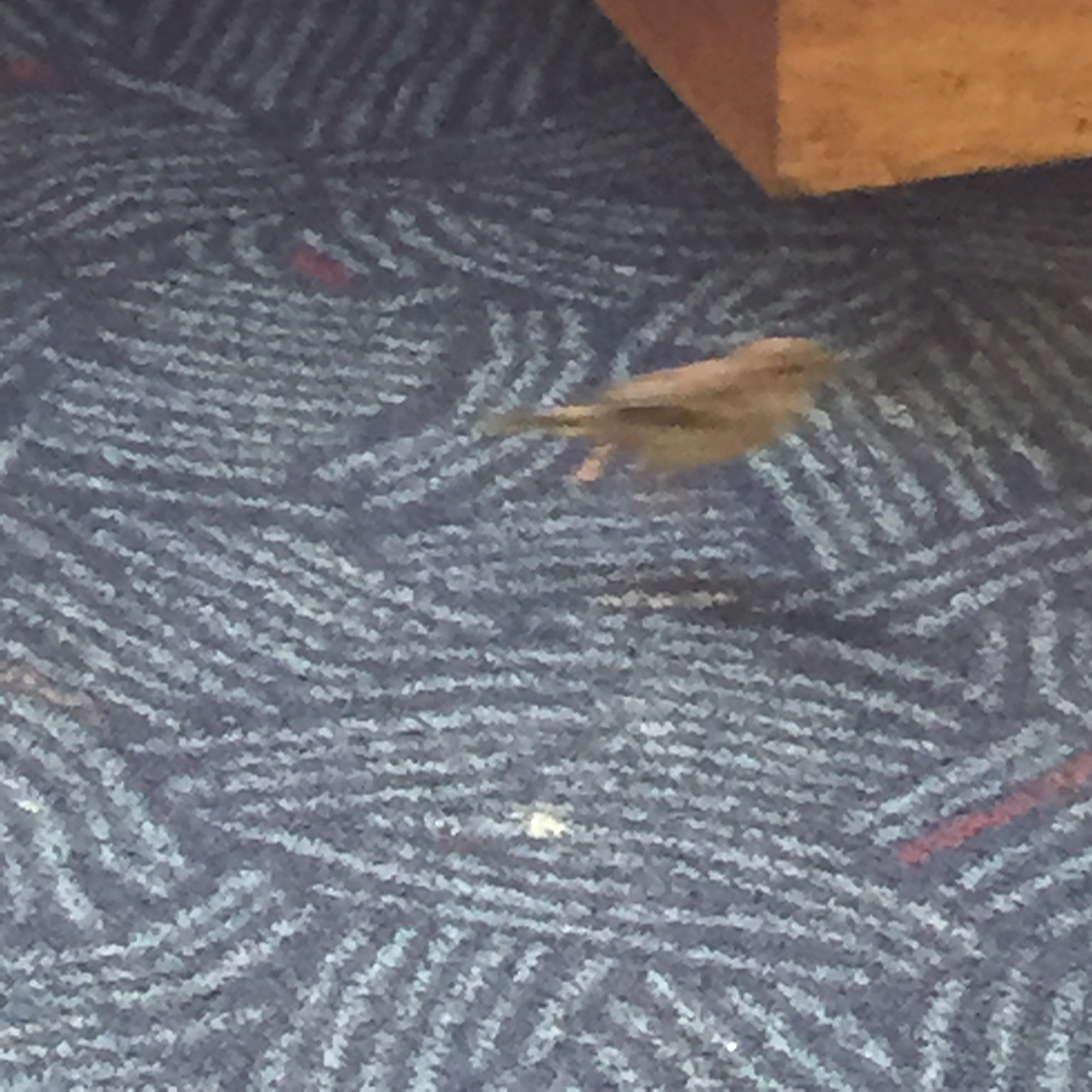
Perhaps it would help if we could actually distinguish the trivial from the monumental. We’ve all had plenty of practice. I once thought in second grade that having a box of 24 crayons in a class where everyone had a box of 48 was a monumental disaster. Now we all know better …. ooooh, was that a Mercedes 17000 XL that just drove by my eight-year-old Honda? You get the idea.
The more I think about this, the more I am convinced that almost everything is trivial. A car model shouldn’t matter. Whether or not the car runs – that’s at least important. If you live downtown in a city with good public transportation, a car may not matter at all. Whether you write on a three-year-old iPad or the newest laptop doesn’t matter. Whether or not you are writing – that matters. Bathroom style – doesn’t matter. Toilet that flushes – that matters. If you look around, you can make your own list.
Cicero’s point is that the relationships we have and the faux pas and trivial events that we allow to affect them should be set aside for more important issues, such as the depth of the relationship. Some day I should blog about the trail of faux pax I have made that caused Ann to roll her eyes. It would be a long list. We’re still happily married. She understands trivia, and I’m learning.
Human Mistake Number 5 – Neglecting development and refinement of the mind. Face it, we live inside our minds, and our bodies are smaller than our minds. I’ve listened to some people whose minds seem to be unweeded gardens. I don’t listen to them for long. I’ve listened to other people whose minds seem to fill the room. Their positive energy, love of life, interest in people and ideas, knowledge of history, and wide experiences make it worthwhile to be with them – along for the ride on this little blue planet.
I’m working on developing myself and recommend it. During any given week, I’m reading some classic that has stood the test of time (currently Antony and Cleopatra), some non-fiction (currently Nepo’s Finding Inner Courage), daily Bible chapters and something else spiritual (currently re-reading Joel Goldsmith’s The Infinite Way), my hobby (currently Ernest Schweibert’s book on stream nymphs – um, of the insect variety), and something modern (currently Donna Leon’s mystery series set in Venice).
I quit watching the news on TV when I concluded it was mostly bad, mostly about incidents of violence, and according to recent studies – mostly untrue. I’m talking about a range of 45% to 83% untrue, depending on the network. I look at headlines online and avoid reading any articles that are negative, attacks on individuals, or sensational. I know next to nothing about current Hollywood and network stars, and I’m almost proud of it. Katy who? There are a few thoughtful writers I trust but do not always agree with. I will read almost anything by Malcolm Gladwell, David Brooks, Paul Krugman, Anne Lamott, John Nichols, Maureen Dowd, Daniel Pink, or Ray Kurzweil. I watch TED talks online while I walk on a treadmill every weekday. I realized that I was terrible at reading music, so I bought a series of instructional DVD’s on learning the piano, so now I’m studying it, not just playing it.
I challenge you to do likewise, whatever developing yourself means to you. I recommend avoiding anything on TV, the net, or papers that induces fear in you, or worse – anger. Anger is poison. The Hunger Games, Game of War, and 50 Shades of Grey are infections. Read Cicero instead. Play chess. Play with your kids and grandkids. It’s amazing what you can learn from them.
Cicero’s Last Continuing Mistake – and Probably the Most Important – Attempting to convince others to believe and live as we do.
I recently read an eye-opening book by Parker Palmer called Healing the Heart of America. He cites studies in which people show a marked tendency to watch only programs that already fit their world political view, and when confronted with facts or events that contradict that view, they only become more set in that view and look for support elsewhere. Facts become meaningless if they do not support their view. This closed-mindedness is often coupled with a fruitless propensity to try to change everyone else’s point of view. I believe his studies are true. The implication for me is a resolve to avoid pointless arguments on politics, religion, or science, especially on Facebook. Instead, I only want to comment in the interest of truth with “That’s not true. Here’s a reliable source.” I may post something surprising without comment in the interest of truth, but even there, I’ve had to follow up with a modification or correction when I learned something additional. I’ve not had any total retractions that I can remember. I am shocked at how easily people repost the most outrageous, scandalous charges without looking anywhere to see if any of it was true. Then I realize there was a time when I was that guy. I don’t go there anymore. It’s like stepping into a tar pit. Tar pits are full of dead dinosaurs, so unable to understand anything different that they got stuck where they were and died. Don’t die in a tar pit. Go along for the ride with me on this little blue planet. Bring a towel and don’t panic. Oh, look, there’s a trout stream in a meadow. You don’t need to find a better universe next door; it’s right here. Let’s go.

 kurthaberl