Fear of Flying and Why I Like It

Ann hates to fly.  I don’t mind it, except for the cramped seats where we travelers don’t just rub elbows, we exchange lint, and our auras become Venn diagrams. I really don’t mind it except for the ear popping on takeoffs and landings, and except for the instructions on how to use a seat belt, a seat cushion, and an oxygen mask. If anything really serious would happen, would any of those matter?  I don’t worry because flying is sort of like a Mexican standoff with fate. If the pilot really messes up and is going to kill us, then he’s going first.  Flying brings into focus for me the only use of math I can tolerate, the reassurance that thousands of flights take place every day and all the planes I see overhead are actually flying, and I’m safer in a plane than in a car, and I’m not afraid of driving, so why should I be afraid of flying? Besides both pilots up there are more experienced and better trained in their jobs than I am at driving a car. The math is on my side, for once.

When I get upset about flying, it’s usually about other things.  Two examples: A few years ago I flew with my brother to Corpus Christi (a rather ominous name if you’re afraid of flying) with a stopover in Denver. When the TSA agent checked my carry-on in St. Louis, she asked me to step aside for a moment, and I wondered if my brother had planted something in my luggage to get back at me for the time I broke his new arrows when I was ten, and he couldn’t shoot his bow.  The agent was staring at her X-ray screen, and said to me, “Please explain to me what that thing is. It looks mechanical or electronic.” I looked over her shoulder at the screen, and said, “That is a spinning reel – for fishing – I’m going to Corpus Christi to go fishing with my brother and my uncle.” She said, “It doesn’t look like a reel to me,” and in a moment five other agents crowded around her screen and they began to argue about its strange spidery shape, loose wire, and should they unpack my bag and see if the wires were connected, and I thought, “God, help me,” and then He did. An old guy who had worked for the TSA on the first Wright Brothers flight shuffled over and said, “That’s a spinning reel – for fishing – hm, it’s not the standard Garcia Mitchell 308; it’s probably a Shimano with a trigger bail and 200 yards of monofilament on it, so let him on the plane.” He was one smart guy, that old TSA agent.

Image

Here’s one my daughter experienced.  On a flight from St. Louis back to Boulder where she is attending grad school, she was also pulled aside by a TSA agent, probably the same one who pulled me aside years ago. “What is that?” the agent said, pointing to a long, dark roll in my daughter’s carryon. “That?” my daughter said.  “It’s a summer sausage that my uncle gave me (the same one who flew with me to Corpus Christi, so there’s a pattern here), actually a homemade venison sausage.  He hunts deer.”  “With a gun?” the agent asked.  “Yes, and a bow and arrow.”  “It looks like plastic explosives,” the agent said.  They unpacked my daughter’s bag, cut off a slice of her summer sausage, and put some kind of chemical on it to see if it contained any flammables, TNT, glycerin, or propellant.”  The test was negative. It seems like the TSA agent thought my brother might be hunting deer with plastic explosives, or if he owned a gun AND a bow and arrow, he could be one of those survivalist, bomb-shelter nuts out to blow up people, including his own niece.

These are true stories. I’m glad the TSA is being suspicious for our own safety, but someone should train them in fishing reels and summer sausage.  I mean, everyone should know about fishing reels and summer sausage. The only question here is: “Why doesn’t my brother ever get stopped?”  The next time I fly with him, I’m going to sneak a little bottle into his luggage of the gel we used in grade school to get back at our friends by putting some of it in a kid’s jock.  It was supposed to cure athlete’s foot and it stung like hell and it was called “Atomic Bomb.”  I wonder what that TSA agent in St. Louis would think when she pulled a one-and-one-half ounce plastic bottle out of my brother’s luggage that was labeled “Atomic Bomb.”  Even the shuffling, old TSA guy couldn’t save my brother, I think.  Not that I would really do it. Thinking of doing it makes me laugh enough so that I don’t have to go through with it.

This brings to mind another story which I believe is true because a Catholic priest told it to us during a sermon about ten years ago.  I forget the sermon, but I remember this story.  (Let that be a lesson to priests everywhere.) The priest was in line at O’Hare Field along with a lot of other frustrated holiday travelers. Behind him came some overweight, blustery guy in a suit who was cursing at everyone and everything.  He ignored the line, wheeled his overstuffed baggage right up to the front of the line and said to the agent, “I’m in the Admiral’s Club; here’s my ticket.  I’m checking this bag, and I want a boarding pass – now!”

She said, “I’m sorry, sir, but even Admirals have to get in line and take a turn.  It’s only fair.”  The big jerk argued with her, then cussed at her, wrote down her name so he could complain, and stared down the rest of us as if to say, “Don’t you all know who I am?”  The ticket agent was polite, no matter what foul things he said to her, but she would not budge and eventually he got in line.

In a few minutes the priest got his boarding pass, but since he had plenty of time, he went back to the agent after the line went down and after the big jerk went to the Admiral’s Club to drink some more.  “I’m going to write to the airline about how well you handled that insulting passenger a few minutes ago. I was very impressed,” the priest told her.

“Thank you,” the agent said sweetly, “but that’s not necessary.”

“Why not?”

“We’ve been trained in ways to stay calm with such passengers,” she said, even more sweetly.

“What do you mean?”

“That man is going to New York – eventually.”

“Eventually?”

“Yes, eventually, and his baggage is going to Tokyo.”

Man, I love flying.

Special: You can now download my literary suspense novel Hibernal for your Kindle or the Kindle app on iPad or iPhone for $2.99 through Amazon.  Just log on to Amazon books and type in Hibernal or Kurt Haberl.  Also, the video trailer is still there.

Hibernal cover

The Cure for the Common Cold

It’s that time of year…

Image

 Two weeks ago I caught a dandy, one of those triple whammy bugs that thrive in a sore throat, invade enough cells to make a person feel 90 and end up in a sinus infection. At one point, things were so bad that my teeth hurt when I sneezed, which was often. Since I firmly believe in Google, which I fact-check with Safari and Izik, I thought I’d do a little snooping around and see if there was some other cure besides the Mucinex, salt water gargle, saline sinus spray, and powdered vitamin C semi-dissolved in orange juice I was taking.

 Image

So here’s the regimen Google gave me to cure a cold. First start with your runny nose by drying out your sinuses with a blow dryer on warm.  Google god says this really works. The size of my nose makes this easier for me than for most people. Then drink a concoction called Gogol Mogol (probably originally from Atilla the Hun’s cook), which is a mixture of egg yolk, honey, sugar and butter in one-half of a cup of milk.  Add a shot of rum and heat it all like a hot toddy.  If you’re desperate, skip the egg, honey, sugar, and milk and just heat the last two ingredients.  Then make a poultice of tallow or some kind of animal fat smeared into flannel on one side and a vapor rub on the other and wrap it around your neck or put it on your chest. Then eat some boiled astralagus root, which is a golden, sweetish herb according to Google known to fight infections. (Known by whom?)  I don’t relly know what astralagus is, but it is currently on sale at http://www.Puritan.com. Yeah, I know, it didn’t seem to work for the Puritans either.  Also, the etymological root for astralagus makes it suspect for me.


For phase two, eat Japanese Unabashi, which is some kind of pickled plum or apricot. Supplement with anything cooked in curry and/or garlic, followed by raw onion and a piece of dark chocolate.  I skipped the curry, garlic, and onion.  The chocolate was good.


There are people who swear that a cold can be cured by listening to jazz.  I didn’t know most strains of rhinovirus (latin for “nose bug”) can’t stand jazz.  I thought hip hop would be more effective, but apparently not.  Some people swear by anything that makes you sweat, apparently one of the ways your body rids itself of poisons. It seems to me, a person ought to be more efficient at ridding one’s body of poisons by just taking a pee.  Apparently not.


People in the Far East say you can kill the cold by eating a big bowl of lizard soup. At this point, I decided I’d rather have the cold for two weeks. I finally came to the conclusion that all those mean people out on the internet were just making up gross, uncomfortable things for sick people to try.  I imagined two seventh-graders with an Ipad somewhere in Florida who wanted to have fun with Northerners by making up sick stuff for them to eat, drink or do. Can you imagine? “Wait, wait, Duane, listen to this. We could have people try to drink melted yellow snow because it would contain antibodies, and there’s no snow in Florida, so our friends are safe.”  “Yeah,” Duane says, “Let’s add yellow snow to the list. Ha ha.”


At this point I decided to go to a real doctor. Amoxicillin is great stuff.  So is Ann’s chicken soup.  Doing nothing is good. If you’re not alcoholic, a little Jack Daniels on ice is nice.  It won’t cure the cold, but you might not notice, and you can pretend you’re taking medicine. Sleep is better.


My cold is now gone and I’m back to my curmudgeonly self. I did it without lizard soup. If someone out there finds the lizard soup works better than Jack Daniels, let me know. Can I get a witness?  Google?   Anybody?

A Dangerous Coffee House

A coffee house is a dangerous place, at least for a writer. The two women at the table next to me are talking about their husbands. Both of their men are apparently evil, and that fact is not changed by the occasional “But he cuts the grass.” One of the brutes is addicted to sports and has no interest in romantic comedies, the current fashionable length of men’s shorts, or stars dancing.  The other woman’s orc likes movies but only the action ones where cars explode, guns blaze, women wear torn shirts and jeans, and men say things like, “Here’s a present for you” and then toss a hand grenade. This Neanderthal only wants to take her to movies that have a number in the title like “Death Wish 6,” and will not trade time with her for An Affair to Remember.  The wives’ conversation epitomizes one of the dangerous truths of a coffee house: Life is a struggle between the brutes and the civilized.

photo-2

Two men sitting at separate tables have the first requirement for entrance to a coffee house in Madison, a laptop, but both screens have only spreadsheets on them.  These men are not brutes; they are zombies, and their occasional pecking at the keyboard shows a shallow fascination with numbers amounting to nothing.  For a moment I thought of the possibility of describing them as T-shirted moguls moving millions of dollars with the flick of a finger and creating or gutting corporations based on the digital cell on an Excel file.  No, I can’t go there. They are boring serfs.

A young man with long blond hair and a bad beard just walked in wearing a black T-shirt that says “KNERD.” His thick, dark-framed glasses confirm his T-shirt. He orders two breakfast sandwiches, obviously not caring about his dietal health, and shares one with a young woman who joins him, her thick-rimmed glasses tagging her as another knerd. They may simply believe that the world will not last long enough for their dietary choices to matter. They are plotting a conspiracy, perhaps something that started years ago by downloading pirated music, but now has expanded to hacking NSA files and creating avatars to protect their own privacy while they expose national secrets, even though there are no national secrets anymore. Their current conspiracy is the result of a chance meeting with a fellow knerd, a biologist, who realized and now can prove that the demise of the honey bee population is not due to mites or weed killers as popularly thought, but rather is the result of recruitment of millions of bees by the CIA. These real killer bees are now equipped with tiny surveillance cameras and mini hypodermics.  They are training in a secret location near Death Valley where escape for them is impossible until their “orientation” is complete. The bees work in trios, two camera bees (stereo vision for depth perception back in Death Valley) that fly in formation with one hypodermic bee. Code: Ciel Team 3.

A young man with Knerd genes somewhere in his background is at a table about ten feet away.  He sits alone, but he is not alone.  On his table are an energy drink, a laptop, an iphone, a mini-tablet, and a portable hard drive. The mini-tablet has a Google view of Fort Knox on it.  He is obviously playing some kind of web-based game. Boring.

Oh no, the two women married to brutes just left, their smiles belying the fact that they are going back to lives of quiet desperation and the never-ending battle to raise the consciousness of the world’s lower life forms. Their smiles are enigmatic, as if just talking about their husbands’ shortcomings has made them feel better. I don’t understand. Now they are laughing. Their efforts are heroic.

In the corner is a bearded, middle-aged man whose eyes have the haunted look of a fugitive.  He is typing furiously, either because his UW dissertation is due tomorrow or because he is writing the Great American Novel.  I’m going to go with the Great American Novel. It is the story of (spoiler alert) Lee, a young man born into abject poverty in Tupelo, a lost child his father nicknamed “Hound” before leaving his mother. Hound left Tupelo and failed in several business ventures involving bees – no, involving suede shoes – until he was drafted into the army. Upon his discharge he became an American icon in the entertainment business, really the only business the United States now has, and then, well, his life ends tragically. Yes, it will be the Great American Novel.  His story is our story, minus the private aircraft, sexual encounters, and drugs. I wish this fellow writer well. If nothing else, he types with amazing speed and dexterity.

photo-1

Sitting near the window is another middle-aged man who has managed to sneak into the coffee house without a laptop. He has an old-fashioned book before him and a legal pad. He writes with a 1960’s Bic pen. His eyes hold the far-away look of a visionary, but one who has seen it all, and it is all bad.  No, he has seen it all, and he knows that it all passes, and the passing is good. He is writing a memoir, a single copy that cannot be emailed or e-booked, and he wants it in a form that reflects his character. His pad will become a manuscript, his handwriting a reflection of his personality and story.  How unique. It is the story of an observer, one who has lived through and studied four ages, the Age of Mass Production, the Age of Mass Media, the Age of Acceleration, and the Age of Everything Apple. He writes on a pad so that his identity/manuscript/ideas may not be stolen. He divides his pages into three piles, one kept in a bank safety deposit box, one kept under his mattress, and one kept in a backpack that goes with him everywhere. Every third page is kept in each safe place. What he sees is … oh no, he is looking at me, and he realizes I am a writer.  This is terrible.  I cannot bear such scrutiny. The observer cannot be observed or he is no longer the observer.   How can I make things up if…. I’m meltinggggggggggggg…….

A coffee house is a dangerous place.

Peace

April 23, is generally regarded as Shakespeare’s most likely birthday, so it would be appropriate to begin with one of his quotations.

“Expectation is the root of all heartache.”

Some think he never said that, since scholars can’t find it in his plays, but that doesn’t matter if the plays were all written by Edward de Vere anyway. Who knows?

The complement to this is the title of the Dickens novel, Great Expectations. As I’ve written before, if something is true, I believe its complement is also true. I love paradoxes. As a retired teacher, I know the power of expectations in a classroom, where behavior and learning are so certainly a function of expectations. A teacher who expects little from his students will most certainly get it. It seems to me that in professional relationships, like those in teaching, which over time become personal, great expectations matter. That may be largely due to an unspoken statement akin to, “I have great confidence in you. You can do this difficult thing.”

Great expectations on a personal level, however, may be sure to bring disappointment. Wives and husbands could keep counselors employed for generations on this source of difficulty, never mind issues of debt, affairs, or addictions. I wonder how many times such sessions began with “I thought he was…” or “She should ….”, “Why doesn’t he …” or “If only she would ….” This doesn’t mean married people should have no expectations of each other. Common courtesy, loyalty, a willingness to help, a willingness to listen, a place of emotional safety, and shared long-term goals are things that matter. No marriage should be in trouble, though, because of the replacement of toilet paper, the position of a toilet seat, or a woman’s underthings drying on any available horizontal pole or doorknob. (I’m not saying my wife does this, mind you.)

Expectations are an intensity multiplier. Take the Super Bowl, for example. It’s still fun for me to watch a championship game played at the highest level, even if I’m not a fan of either team. I will always favor one side a little, but if my team loses, I’m not going to go out into the streets to overturn cars, set trash cans on fire, or break windows. If my team wins, I’m not going to go out into the streets to overturn cars, etc. If I really am a fan (short for “fanatic”) of a team, I may experience highs and lows that come from each individual play and range from extreme anger (that ref called WHAT?) to extreme elation, (Take THAT, in your face, you jerk!) Such extremes may be tolerable, perhaps even preferable for those who enjoy a sport, one of our substitutes for outright war, but I don’t recommend it as a way to live one’s life.

In the 60’s we youth (yes, there was such a time) used to tell each other, “Peace and love,” which kids of the 80’s turned into “Peace out.” It was the primary way many of us fought the Viet Nam war. There is something to be said for that attitude. Emotional highs and lows are not nearly as healthy as a whole series of little highs. If you don’t expect your wife to fill up the car with gas, but she does, what a nice present that is. If a husband isn’t expected to clean the bathroom, but he does, what a nice present that is. The point is that expectations always carry judgment, and it’s so much healthier to simply observe what is, rather than judge what ought to be but is not.

This is one of the primary ways in which a person lives a life in peace. Because I cannot control other people, games, the weather (ah yes, the weather lately), the timeliness of other people’s arrival, traffic, the news, politics, where birds deposit excretions, which direction the wind is blowing, or what someone just said to me, the solution is not rage, disappointment in expectations, or depression. To misquote Shakespeare or Edward de Vere, “All the world’s a TV show.” If you don’t like what you see, don’t throw the candy dish at the screen or yell at your kids, change the channel. Observe with interest, and if you don’t like what you see, look at something else. You have the TV clicker for your life. It’s in your pocket right now. Peace out, everyone.

Busts, Death, Toilet Seats, Life, Irony, Apples, Stones, and Eden

So I’m sitting in the Arcadia Bookstore in Spring Green, Wisconsin, with my daughter, our keyboards clicking like self-running machines, and then I can’t write anymore. How do you write in a bookstore/lunchroom with a bust of Shakespeare on the top of a bookshelf staring down at you? I could quote him, I suppose, to get him off my back, but then he would just frown and say, “Plagiarism is not writing,” and I would answer, “You plagiarized everyone, including your friend Marlowe,” and he would answer, “Yes, but I did it so well, so much better than the original.”

As if I or anyone today could do that, even with the modern aid of high octane caffeine streaming through my veins like a torrent of contradictions from “To be or not to be…”

I don’t believe we can write if we’re trying to outdo someone, even if we’re only trying to outdo ourselves. Since I’m currently writing to entertain rather than inspire, I see that it’s time for a joke, or at least a modicum of irony. So I just went to the men’s room after a nut brown ale, some chili and a cup of coffee and found the ultimate women’s revenge, here in this bookstore/lunchroom run by women. It was a spotlessly clean men’s room, with a toilet lid that would not stay up. It’s one thing for them to complain about putting the seat down, but to go this far, to install a seat that will not stay up – that’s just too strategic, especially in a room women will not use. It seems like one of the women had a slightly too-large smile for me when I walked past the counter. The bust of Shakespeare is not amused.

Now I look past my dauighter and I see an ironic metaphor for our country – stacks of books with No Easy Day, the Navy SEAL’s account of the killing of Bin Laden, next to another volume entitled, The New Deal, a study of FDR’s plan to save the country. Death or life, which will you read?

Writing is “righting,” an attempt to make life better, or at least to shine a light on something wormy and so to make it shrivel and die. Writing is building something with words, a city or a life. The words are humble things, like the stones that become a cathedral. All life is metaphoric if one looks at it closely enough. It is so much more than the thing itself. An apple is more than an apple; it is a logo, a variable of gravity, a temptation that boots our parents out of Eden. An apple is more because our thinking makes it so. The apple does not matter. It could have been a walnut, a potato, or a plum. What matters is not the color, shape or taste, but rather, the fact that it fell and someone noticed it and saw there was meaning there.

Writing is that meaning, the moment someone picks up a stone, an apple, or a plum, studies it for a moment, and then smiles. “What?” says a friend, who is not a writer and does not hold the apple like truth-in-hand.

Will Shakespeare, you need not smile at me like that. I have held an apple in my hand and smiled at it when I saw that it was alive, teeming in its redness, redolent with sweet juice, firm as flesh, and holding in secret a truth we can hardly imagine. What is that secret? All things fall, and the falling is a beautiful thing to those who understand it. The falling makes an apple so much more than an apple. A fallen apple is one of us.

I am a writer. When you fall, I will bear witness. When I fall, someone else will witness. It is a beautiful thing.

Just for the record, I do not recommend taking too much caffeine in very good coffee after a bowl of white bean chili and a nut brown ale, even if Shakespeare smiles down upon it. It means that you will write about busts, toilet seats, life, death, apples, irony, stones and Eden. Yes, Will is definitely smiling at me.

Where Happiness Comes From

It’s not really a secret, except to those poor souls who are not happy. Having seen the documentary “Happy” and tested its thesis, I can say that it’s exactly right, and I highly recommend it. If you haven’t seen this movie, get to it as soon as possible.

Once you have the basics covered, say $50,000.00 worth in the United States currently for house, food, basic medical care, wearable clothes and some fun money, people who make twice that, three times that, or twenty times that amount, are no happier according to every survey and measure available. It’s also true that many people can be happy on making less that $50,000, as long as their basic needs are met. The Jaguar XKE (do they still make that hot ride?) won’t do it. The trip to Hawaii won’t do it, at least not beyond the actual time spent there. Drugs won’t do it. If marriage alone did it, there wouldn’t be any divorces. Sex won’t do it, although I must admit, my wife has a kiss that, um, well, nevermind, there may be an exception to what I’m about to suggest.

First, a clarification. Grammatically, we have it all wrong. Happiness is not really a noun; it’s a verb. “To be happy,” doesn’t work because that is passive. “To happy” would be the correct form. So what does one do “to happy?”

It’s not necessarily easy for most of us, but it is simple. Adopt everything and everyone. Adopt the local barber so he becomes your uncle. No one can tell better stories than Uncle Jack the barber on Old University. Adopt a local coffee shop like The Froth House near us (where I am as I write this), and be sure you know the names of the baristas. (Thank you, Ginger. How is Kelly doing?) I read in college that Daniel DeFoe of Gulliver’s Travels fame, not only adopted a local pub and had dibs on “his booth,” but also had his own friendly waiter named Payne and was truly saddened when the waiter succumbed to the plague. Until death, they were happy because of the relationship.

Adopt the places where you belong, a restaurant, a pizza place, a library. Keep going to those places until you belong. Adopt the people who work there and find out about their children, husbands, vacations, and worries. Adopt a local hardware store and find out who knows the most about plumbing, dimmers, and ant killers. Adopt all of the neighborhood kids, especially at Halloween, during the summer, and at graduation. If your neighbor has a dog as nice as Lukas, the collie next door to us, be sure you have a box of dog biscuits near the back door. It’s not only fun for Lukas; it’s good for you. Adopt a local baseball team, a football team and a basketball team if they are available, especially if one of them is semi-pro. Jane, a fellow teacher for many years, adopted struggling players for the Kane County Cougars near Chicago and took one in as a roomie every year. Jane and her husband became adoptive parents and the team’s best fans. They belonged. She and her husband often went to spring training, but even more important, they kept in contact with “their boys” for many years whether the players made it to The Bigs or not. Jane’s eyes lit up in delight whenever she talked about her boys.

Adopt a TV series, an author who writes a series, preferably something not about vampires. Wizards are okay. Adopt a band, especially one most people don’t know about. If you don’t know of such a band, ask a young person, preferably one you’ve already adopted. Adopt a trout stream. Adopt plants. You can name them if you want and talk to them. They can’t hear you except for perhaps mild vibrations, but talking to them can be good for you, as long as you also talk to people. Adopt a musical instrument. Adopt a blogger or two. Adopt the elderly, especially if they are in your neighborhood and too feeble to shovel snow. It’s actually become something of a rivalry in our neighborhood to see who can get out first to shovel the walk and driveway of the very elderly couple on our block. Adopt a charity, a university, and a favorite chair.

You already know the point. Happiness is not based on prestige, class, or what you own. It is based on deepening relationships where you live and where you go. When you hear the echoes of John Lennon in “Love is all there is,” this what he means: you love and are loved by creating meaningful relationships.

This is also where it gets tricky, or at least interesting. Owning something is not the same as developing a relationship. That’s why buying that Jag XKE that you admire so much may seem to make you happy, but only until its first scratch, while having a kind of loyal relationship and appreciation for an old 1957 Chevy may make you quite happy. You “happy” it. Happiness is never owned; it is created, usually slowly, deeply, and personally.

This is also one of the blessings of happiness. It does not depend on the other thing or person. That’s why a car can’t make you happy, but you can happy it. That’s why crabby Mrs. Longnose on the corner can’t make you happy since you never hear a kind word from her, but you can “happy” her, and will be amazed at the results of your conscious, repeated and infuriating kindnesses. Do you really want to get back at her? Kindness is the sweetest revenge. It’s not really revenge, but that needy part of your brain will be filled with the resulting dopamine molecules anyway. If nothing else, you will confuse her, and that’s not all bad.

You don’t have to take my word for it. You can see happiness in action. Simply go to bethesourceproject.com. There it is. It’s a blog worth adopting.

Marry Someone Who…

It’s a good thing to know you married the right woman. I suppose this is an ode. I wrote one for her once before, a song before we were married which said, “The road is long between our two towns,” but I don’t remember all the words and I’d have to go looking for the manuscript, which is a problem in our basement full of unpacked boxes. Thirty years of marriage and two children result in a lot of boxes.

So how does one know? Start by marrying a person who will drive from Madison to Evanston to the home of a new grandson so she can hold him between feedings, ignore everyone and everything else in the room, and do nothing but study his face and murmur to him for three hours straight.

Marry someone who prepares for moving by digging up snowflowers and asparagus given to her by her grandfather twenty years ago and irises given to her by my father and replanting them over the winter in a friend’s garden and then driving two hours in the spring to dig them back up to replant in our new yard. These are not flowers; these are valuable legacies left to her by loved ones. She treats people the same way.

Marry someone who loves to paint rooms, has an unerring eye for color, and is so good that she never needs to “tape” edges or woodwork. I do ceilings – with overlapping dropcloths, and when she laughs at my ineptitude, I pull out my Bunbury excuse, “You know I had a detached retina fixed.” Marry someone who lets you use the re-attached retina excuse on everything from painting ceilings to forgetting to pick up milk.

Marry someone who doesn’t want a king-sized bed and would rather “spoon.”

Marry someone whose first choice in cars is the oldest, boxiest Jeep she can find, and only then when Wagoneers are no longer available.

Marry someone who will fill a blackboard-painted wall with a colored chalk drawing to welcome home the new grandson, and do that after a day spent in scrubbing sinks, countertops, doing laundry and cajoling a repairman to rush over that day to fix the dryer by convincing the business owner that a new mother and her baby can’t possibly come home to a broken dryer.

Marry someone who needs less than five minutes to get “sucked in” to an old black-and-white movie on Turner Classic Movies, even a two-star movie, someone who enjoys the vintage clothes as much as the characters, and assumes that the plot doesn’t matter.

Marry someone who owns a lake out in the deep woods of the Upper Peninsula, especially if she has a brother who’s an engineer who knows how to build solar-panels and hook them up to a refrigerator, one who loves solar showers. Marry someone who can row a boat and will force her husband out of the tent at night just to look at the stars… not the pathetic suburban dozen or so lights that peep through the urban night clutter, but the honest-to-god Milky Way and shooting stars that still live in the U.P.

Marry someone whose favorite possession is a 50-year-old Peugeot ten-speed bicycle inherited from her aunt.

Marry someone who volunteers every week in her new friend’s second grade class because one student in particular needs one-on-one help. Marry someone who knows this is how to keep the same friends for over 50 years.

Marry someone who calls for computer help because she believes the computer will explode if she hits the wrong button. Marry someone who almost believes you if you tell her it might.

Marry someone who fills entire jump drives with digital pictures of clouds and fields taken out of a moving car – pictures that she might paint some day.

Marry someone who reads the Arts Calendar with the same intensity as she reads The Secret Life of Bees.

Marry someone who knows that music is not a monologue; it is a conversation.

Marry someone who knows that football is a father-son adventure; fly fishing is like yoga or meditation; the woods are as sacred as church; water must be painted as if it is alive; the right kind of warm light bulb matters; friends are more important than money; a lonely day is a day with fewer than a dozen phone calls; hot buttered popcorn with lots of salt is its own food group and popcorn is a requirement for old black-and-white movies on the Turner Classic Movies network.

Marry someone who remembers all the names for the faces you recognize, but can’t remember where her dozen reading glasses are.

Marry someone who will badger you to take a nighttime walk, especially if it looks and sounds like rain on its way.

Marry someone who will see a high school fight brewing in a parking lot and will drive her car at a crawl right into the middle of them even though she is alone, horn blaring the whole time, until the kids get scared and run away.

Marry someone who favors old things: houses, friends, books, jeans, furniture, recipes, coffee mugs, jewelry, family stories, and a husband.

Marry someone who laughs like a little girl, wears honesty like a tiara, prays a blessing every time a helicopter flies over our house to the nearby hospital, walks up to the high school when she hears a bagpipe band practicing, and babysits for friends so she can adopt their children. There are never enough children.

Follow these guidelines, my friends, and you will marry the right woman.

Hibernal

If you like these posts, be sure to check out my literary suspense novel, Hibernal, a Winter’s Tale, now available in paperback and Kindle at Amazon.com.

Modes of Thinking

Yesterday I went to the Flyfishing Federation’s “Opener” in Madison and listened to a talk by one one of the best writers and flyfishers in America, Dave Hughes. Surprisingly, he began his presentation by recommending one of my favorite books, Blink, by Malcolm Gladwell. His point was that the more you fish or know about anything, the more you can trust your instantaneous intuition or judgment about it — where the trout are, whether you can believe what someone just said, or who this person standing before you really is. That led me to thinking about thinking. Here’s what I think…..

I have experienced the truth that an immediate thought about someone or something, an intuition or immediate feeling, almost without thinking, is most often true. You may not be able to judge a book by its cover, but if along with the cover you sense the condition of the book, hear an opening line, notice the poor spelling, the lack of punctuation, and the sense that you are being drained while merely holding this book, trust your judgment.

I’ve also noticed that in most discussions, especially those that may be heated or confrontational, men are at a disadvantage. Women process feelings more quickly, and often men (or at least I as a man) don’t think of what I really meant to say until the next day. It doesn’t really matter because nearly all arguments are useless. Even if you win, the couple loses. Jackson Browne said it in “Tender is the Night,” when he sang, “I win; you win; we lose.” I believe I have been saved from many difficult apologies by NOT being able to say something hurtful or defensive until I think of it the next day when there is no opportunity to say it. In any disagreement that is not about safety or probable disaster, given a choice between being right and being kind, always choose being kind. All relationships are reciprocal, and no one really wins unless both win.

I also know that much of our thinking is comparative. Making comparisons is a useful tool that allows us to get through an ordinary day. It’s important to be able to compare green lights, yellow lights and red lights. That is especially true when she says “Well….okay.” Is that really a green light or a yellow? However, most comparisions are not that helpful. As I’ve written before, who is the better artist, Van Gogh or Matisse, Beethoven or Mozart? Why am I not as lucky/rich/handsome/popular as….. Such comparisions really are odious. I need to be careful of such dangerous thinking.

The thinking I find most intriguing is “deep well” thinking. This most often is creative thinking. Like a deep well, getting anything out of our superconscious takes time, and the deeper the well, the longer it takes to get that bucket of cold, clear water up to the surface. I read that Mark Twain worked for quite a while on his masterpiece Huckleberry Finn, the book some have called the Great American Novel. I agree that it is not a young adult book, more the coming-of-age book for an entire culture. Halfway through his manuscript, Twain had Huck and the slave Jim a long ways down river, with no way to get them back to Hannibal or end his story. He put his manuscript in the back of his roll top desk. Two years later, Livvy insisted he clean out his firetrap of an office, including his half-smoked cigars. He found the manuscript, read the last few chapters, and immediately knew how to write the rest of the story. He said he finished it in less that seven weeks. We’ve all had “aha!” moments while not consciously working on a problem. The solutions come in the shower, on a walk, while shaving, and sometimes while talking to someone. My advice is: trust what comes out of your well. Most often it will be helpful. We are wondrous creatures. The miracle continues. Drink deeply from the well; the water is cold, pure, and soul refreshing.

What a Piece of Work We Are

Yes, bears have a better sense of smell because they need it; yes, eagles have better eyes because they need them; yes, lions can run faster because they must, but….

Have you ever noticed that you can feel whether the ultra-thin looseleaf you just picked up is one sheet or two? Amazing. Because of that sense we can play piano and caress a lover. Poor bears. Have you ever noticed that thousands of hairs can hang down your neck or over your temples, but only the single hair that is unattached “itches” enough that you can tell it is not part of you anymore and you must pick it away? Poor lions. Have you ever noticed you can tell which family member is walking up the stairs by the mere sound signature of her walk? You cannot hear what dogs hear, but you can tell when the alto next to you is singing a B flat instead of a B. Poor eagles. With practice, you can tell twins apart. You can type 50 words per minute. You can tell when your wife says “whatever” whether she really means it doesn’t matter to her or it really matters a lot. Poor eagles can’t laugh. Or kiss.

I will admit that I am making unfair comparisons, and I believe most comparisons are pointless. For example, who is the better artist, Van Gogh or Matisse? Good luck with that one. The point is that we need not make comparisons to animals to realize our magnificence. We can do almost anything we choose with desire and practice. We can read. We can read music. We can love. We can remember. My wife tells me anyone can learn to draw. If you don’t believ\e her, page through any book by Betty Edwards, especially Drawing on the Right Side of the Brain. Consider all the things a quarterback, a point guard, or a pitcher can do at the same time. Look at a pianist very closely and you will see how his left hand can play independently of his right hand, as if he has two brains, which he does.

For us, even the ordinary is magnificent. Dot an “i.” Waltz or moon walk. If you want to learn to play guitar, really want to, you can. Anyone. If you want to write a book, really want to, you can. If I can, you can.

So what is next for us? In our magnificence, I believe we will soon cure cancer by identifying and limiting the proteins and other compounds that cancer cells need to reproduce. We will also learn to program our T cells, the infection killers in our bodies, how to tell the difference between cancer cells and normal cells. Even better, we will learn what turns cancer cells on to prevent them from happening.

In our magnificence. we will learn to communicate in ways that are respectful, non-violent, and enlightened. Heaven knows (and heaven really does know), we need that amazing skill right now in this political year. Read Non-Violent Communication by Marshall Rosenberg, who studied under Carl Rogers at the University of Wisconsin.

In our magnificence, we will solve our energy needs. It will be electrical, solar, and biological, not petroleum-based.

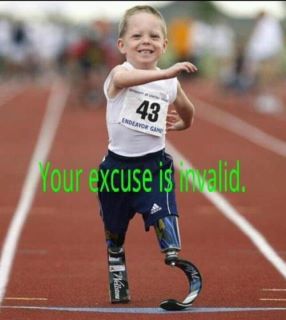
It’s time to get excited. As the poster by George Takei says, “Your excuse is invalid.”