
My last literary suspense novel is now available through Amazon for $4.61 paperback or $2.99 for Kindle download.
When I was teaching high school, I realized eventually (I say “eventually” because I am a slow learner and I think slow learners make the best teachers – not really, but it’s what I told myself) – that one of a teacher’s best tools was a Dayrunner. For those of you under 60, a Dayrunner was a calendar book, a daily planner with sections for birthdays, notes, phone numbers and addresses, and they were usually bound in fake leather with a flap that snapped. Each daily page was sectioned in 15 minute intervals, which was about ten minutes beyond my attention and mid-term memory span. Today your mobile phone and calendar app take its place, and if you’re sentimental about having a Dayrunner, you can still get a case for your phone in fake leather with a flap and snap. I know this for certain.
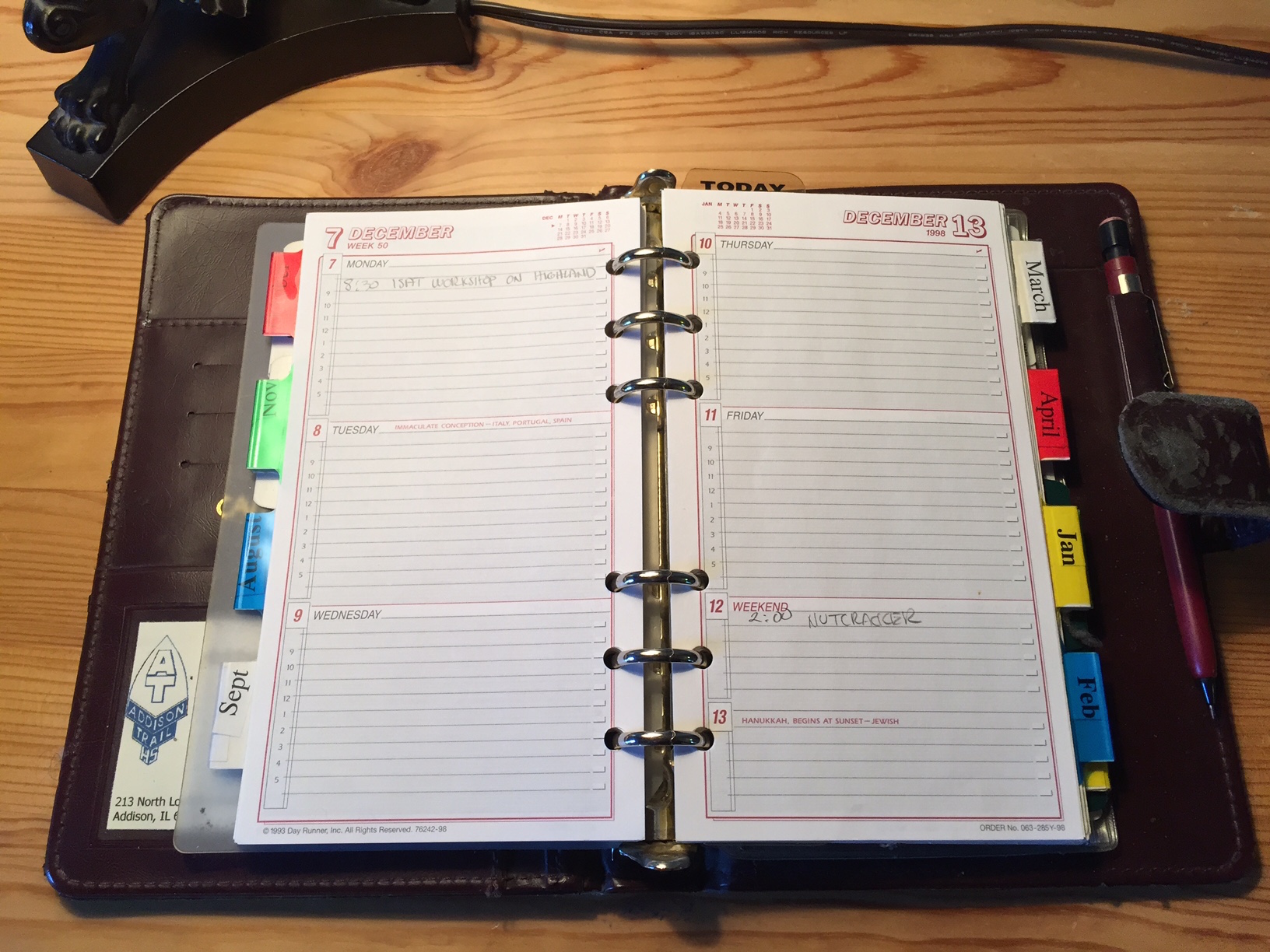
Since teachers make hundreds of decisions and plan, plan, plan, my Dayrunner was filled with things like: “See Joey about his paper. Sign out two class sets of To Kill a Mockingbird. Reserve the video player for Tuesday. Call Mrs. Jennings about her junior high spelling bee. Call Tech to see why my grading program won’t record attendance. Grade 100 essays.” You get the idea. One of the interesting things about most teachers is that they are eternal optimists, mostly because they think at the speed of light, and imagine that time is so elastic that they can grade 100 essays in only an hour and a half. Those papers will be so wonderfully written that all a teacher will need to do is put stars by insightful passages, circle one comma splice, slap on an “A,” and write, “Paulette, this is the best piece you’ve ever written.”
On bad days, a Dayrunner was a frustrating record of how things can go wrong. Once entries on other people’s Dayrunners come into play, and they start calling YOU at 10:15 as scheduled by them for help with THEIR problem, your morning schedule is pushed off till the afternoon and then the next day, and inevitably, the next week. Eventually, everything important gets done, but often that means the 100 essays are started at 10:00 P.M. on a Sunday night after everyone else had gone to bed. All teachers know what this is like, and it is why they celebrate snow days, not so they can put on cross-country skis to admire Nature, but to deal with the Dayrunner and do papers. A Dayrunner is sort of a Sword of Damocles hanging over a teacher’s head.
Teachers suffer a typical kind of procrastination. They don’t really procrastinate as a general rule; they procrastinate something they dread, like the enormity of 100 essays, for something else that must be done that is less distasteful, like planning a unit that will excite students and make them wonder about Rites of Passage, justice, and the importance of parental example, in other words, To Kill a Mockingbird.
It took me an entire career to learn how to use a Dayrunner effectively, and now no one uses one, so I’m asking you to transfer anything useful that you read here to your calendar app, sticky note, or – worst case scenario – inked on the palm of your hand if you’re a high school girl who had her phone taken away first period because you were cartoon-izing your teacher and her bad hair.
Anti-Procrastination Performance Strategy 1: DO NOT WRITE “GRADE 100 ESSAYS” ANYWHERE IN YOUR DAYRUNNER. Instead, write “Grade 5 essays” in your Dayrunner. I have regularly preached the rewards of reading Anne Lamott’s book on writing called Bird by Bird, the story of how her brother broke down at their family’s summer cabin when he had not started a report to get into a special program and needed it in two days. Anne’s father, to his credit, helped his son do one page on one bird, and then taught him a life lesson: That’s how anything gets done, a project, a book, an education, a life – bird by bird
Is cleaning your house a daunting task? Clean one room every weekday. Want to write a book? Write one page every weekday, and in a year, you’ll have a book, actually too much of a book and you’ll have to cut 75 pages. Is it too daunting to save a million dollars for retirement? (Admittedly, if you’re 60, it’s too late). The pros say the greatest advantage young workers have, which is more important than a lot of money, is time and compounding. How to do it? Put 100 bucks a month into a big, total-market investment like a no-load index fund, and have more put in automatically, so you don’t even know you had it. The next year, put 150 bucks away. If you don’t have an actual career, put 10% of whatever you DO have away until you actually find a career that will pay you more than a hundred bucks a month.
Do you want to build a successful marriage? Do something little for your wife – unasked – first thing every morning (coffee in bed? a shoulder massage?). It’s better than money in the bank. You get the idea. Procrastination is often a result of feeling daunted – the job is too big; there’s not enough time; there isn’t $100,000 to invest, I have over 100 essays to grade. The solution is to forget about the end result, and just take the smallest first step possible.
Last month I shocked a Schwab account guy when I told him I wanted to open a Wilshire 5000 total market investment with 200 bucks a month automatic deposit, using the advantages of time and dollar cost averaging, and he said, “But you’re retired now. You should be taking money OUT of an account.” I told him, “You don’t understand. We’re getting by okay. This investment is for 20 years from now when we will need assisted living care. It’s money I won’t even remember I have. I will put more in by automatic transfer, a little more each year, and my wife or my kids will take it out when I can’t remember my name.” I love small steps because I can do them.
A.P.P.S. 2: DO NOT SCHEDULE EVERY MINUTE OF EVERY DAY. Teachers, especially, are too optimistic about how little time any one task may take. If you are semi-retired like me, I find it works if I limit myself to two things I want to get done in the morning, three things in the afternoon, and two at night. If you’re working full-time, it would only work to put one thing on your list for the morning, two in the afternoon, and one in the evening. If you’re taking your grandson to a water park, as I’m doing today to counter a month of sub-freezing temperatures, all Dayrunner plans are off. Anything else that gets done is just a bonus.
A.P.P.S. 3: PLAN REWARDS AND NEVER, EVER BEAT UP ON YOURSELF FOR A DISTRACTED DAY. We’re all kids at heart. Earned rewards are always more effective than punishments. M and M’s are great for grading papers. Sometimes I tell myself, “If I just finish cleaning the bathroom I’ll reward myself with Downton Abbey,” but for me chocolate works better than anything else to get myself to take that first step.
Sometimes the best thing I can do after a distracted day is to tell myself, “Well, that didn’t go so well.” It’s far better than telling myself, “I’m so stupid, so lazy, so …” There’s a big difference between noting the reality that something didn’t go well and telling yourself you are bad, crazy or worse. Shame is evil.
A.P.P.S. 4: As I’ve reported often, I learn a lot from reading. One of my recent adventures is a very useful book by Charles Duhigg called The Power of Habit. I highly recommend this book. “Power” is the right word in his title. What I have found is that it is possible to take a little thing, make it a habit, and then it no longer needs to be on your Dayrunner list. For me, it is now automatic to get up, stretch for 20 minutes, and then get on our treadmill at a good pace while watching TED talks or some documentary on my iPad for half an hour. I don’t procrastinate because I don’t decide to do it or not do it. I do it almost without thinking, and then, psychologically for me, my Dayrunner morning actually begins after the treadmill. If something interferes, if I am sick or away for a while, it takes me a week or two to re-establish the habit, but that’s not too bad. When I’ve been camping or visiting relatives for a while, often as long as a week, I actually look forward to the feeling of getting back to a routine and some habits that I feel good about. It’s probably chemical, something in my brain. Dopamine, Oxytocin, Serotonin, or Endorphins, one or more of those. If I get a daily D.O.S.E., I’m good for the day. Magically, they come from stretching and walking on a treadmill. Go figure.
Anyway, A.P.P.S. 4 is simply: MAKE A GOOD THING IN YOUR LIFE A HABIT.
A.P.P.S. 5: MEDITATE. I have found that meditation is a game-changer. Procrastination often appears in my head as a clash of bumper cars or the experience being in a room with three TV’s on different channels and two stereos on at full blast at the same time. T.M.I. or too much everything, including worries, a Dayrunner list, next week’s trip, something stupid someone said to me, something stupid I said to someone else, where are my keys, phone, wallet, glasses, or FitBit? I can tell when this bumper car experience is about to happen when I go downstairs to set up a recording of a Turner Classic Movie and don’t even get to the TV because I’m sidetracked by a dirty T-shirt that somehow launched itself to the floor, then a coffee mug perched precariously on the edge of a counter, a coffee pot that is empty but still on, a phone left off its charger that is now blinking at me, the beeping of a finished dryer cycle, a window left slightly open and it might rain – I’m not sure, so I’d better check my weather app – a hiking shoe left in the doorway and where is its mate, and finally why did I come downstairs? It had something to do with the TV, I think. You get the picture.
I don’t think it matters how a person meditates. In the Middle Ages, the monks called in Contemplative Prayer. Sometimes I count breaths and just focus on slowing down. Sometimes I put on headphones and listen to sounds of nature or soothing music. Sometimes I name all the people in my life, beginning with Ann and radiating out as far as I can go and simply bless them. Sometimes I go on an imagined happy journey to a campsite or trout stream. Sometimes I pretend to fly and go on wonderful flights through clouds and over meadows and mountains. (This happens after watching The Sound of Music.) Sometimes I have a conversation with God and tell my Beloved Spirit how I’m feeling, and ask questions and listen. Sometimes I pray a rosary, soon soothed by my own droning repetition as I finger a bead and name a person I intend to bless with that bead. I don’t know if it does anything for them, but it does wonders for me. Sometimes I reach the point where I’m just staring at a blank wall, or maybe I’ll stare at one of Ann’s landscapes, not thinking of much of anything until a brilliant idea comes to me from the depths, or a stupid idea, or no idea at all. It doesn’t matter. I always come out of the trance better off than when I went in. The most important things happen in silence.

From the trance, from the place where the bumper cars and the noise of competing TV’s in my head have shut down, I find I can actually focus, and with no competing voice, I can write a blog I was thinking about or maybe one I was not thinking about. Sometimes after meditation, a blog writes itself.
 kurthaberl