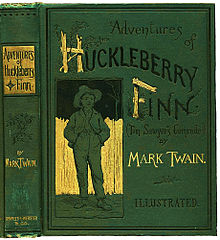
Probably the most famous bout of writer’s block infected Mark Twain, who wrote the first half of his sequel to Tom Sawyer, got stuck, and then finished The Adventures of Huckleberry Finn in a rush after about a four-year interval. Four years is a long time to have writer’s block, although in Twain’s case, it meant that he simply moved on to other things.
I have also heard that a serious strain of writer’s block attacked Sting, who wrote lots of songs with The Police, had a full solo career and then everything stopped – for years – until he learned to write songs that told stories or explored the past and characters he created and were not just about a current topic of interest. He learned to do what Mark Knopfler has been doing in music for years – don’t just report in music something that occurs to you or happens to you – create it and people the songs with your creations.
That’s the first of my practices for defeating writer’s block – Wait it out. Wait for people and things to appear. Waiting is difficult for a writer, even for a day or two. A day or two may be an average gestation period, nine months is a scary period, and four years is too long. Twain once commented that writing required an “incubation” period and trusted his subconscious to be working even when he was not. My subconscious often goes fantasy fishing instead of working on a story, but it comes around eventually. I have less control than early Greeks had over a muse, and they apparently had none.
What is one to do while waiting?
My second strategy to cure writer’s block is to write about other things. Blog, do journal entries, begin a second Great American Novel, write love letters to your enemies to confuse them, and if you’re really desperate, do crossword puzzles so you are thinking about words you almost have in mind. That searching for words is not much different than the actual work of writing. Besides, anyone who is only working on one piece at a time is probably not a writer – he or she is a journalist with an editor breathing down his or her itchy neck. Those poor unfortunates may sometimes end up doing what no self-respecting writer would ever admit – write crap on a subject they were assigned; they know it will get published but few will read it and no one will remember. They do it because they have to – until they switch jobs.
Strategy Number 3: Re-read and keep re-reading what you have written, from the beginning if necessary, so your subconscious gets so bored with it that it will be forced to come up with something worthwhile just to get you to stop breathing down its neck. If you really want to aggravate your subconscious into becoming your working partner again, re-read what you’ve been writing right before you go to bed. That way, your subconscious is primed to dream about what you’re writing instead of that strange trip to a lush isle where something or someone is rustling the bushes behind you. To a balky subconscious, re-reading what you’ve been writing is like planning for a dreamland flight through the Grand Canyon without a plane because you can fly, and then just before the take-off – wham, you’re grounded. You can cure writer’s block by nagging it unmercifully. Since your subconscious is probably a teen-ager (I believe most are), the nagging is much like getting it to clean its room. Wonderful, forgotten treasures often appear, and if not, you’ll at least get missing socks to pair with their orphan brothers.
Strategy Number 4: Take Courage. Sometimes writer’s block is simply due to fear, the kind of thing Harper Lee apparently faced after penning the magnificent To Kill a Mockingbird. She may have been writing after that, and perhaps her second book, The Watchman, may actually appear twenty years after Mockingbird, but I find it quite understandable (though not from experience) that such first success would be hard to follow. There are certainly times when a blank screen – that terrible white ghost like a vaporous Voldemort in Harry Potter – dares you to make a fool of yourself and challenge his unwritten threat. That white screen is sometimes not a playground; it is an abyss. It need not be white and blank; it may be a black hole into which all words and thoughts spiral, never to re-appear.
If that happens, first write an incantation. A prayer would be more effective, but I’m going to stick with the original metaphor. Simply write: Lexicus apparatio spirituus maximus or any Latin-sounding gibberish to the same effect. Then you say, “Take that! Voldemort, you hollow-socketed, whispering bog-wallower.” Then you can launch a courageous attack with words – power words are best – as you write an action scene using thrust, juggernaut, thunder, hurtling, stormed, defiant, stanchion, surmount, and end the paragraph with something magnificent, such as, “and so truth rises.” You will probably keep none of it, but you will be writing, and the blank screen will become your canvas, your sandbox, your whiteboard or your sky. Write courageously; write with anger, if necessary.
Courage always can defeat fear, but you have to make it so. Fear only wins when you let it. The more you practice courage, the more of it you will have until one day, you face even the palest, most vaporous white screen and say out loud, “Bring it on, you pale, sucking nothingness.” Then you write.
When that session is over, you give yourself a medal. Mine is usually chocolate. Edible medals are the best.
Strategy Number 5: Write without Expectations. Do not judge. Just write. Do not edit. Just write. Do not expect anything good. Just write.
I have found that an interesting thing happens when you write without expectations. I will sometimes write five pages of useless drivel, and then suddenly on page 6 an amazing paragraph or two will appear, as if out of nowhere, and I wonder, “Where did that come from?” and immediately I don’t care where it came from; I just go with it, and it goes to some place wonderful. You don’t have to keep the first five pages.
If you practice shooting 200 free throws every session, no single group of 10 will be remembered, but eventually you will make 7 out of 10 and then 8 out of 10. An interesting thing happens when you practice writing like you shoot free throws. It looks like this. Miss. Miss. Miss. Miss. MAKE. Miss. Miss. Miss. MAKE. Miss. Miss. MAKE. Miss. MAKE. MAKE. MAKE. In shooting free throws, even the “makes” fade away, but in writing, you keep the “makes.”
Your “make” may not even be part of a story. Maybe it’s backstory. Maybe it’s a sketch that becomes a flashback. Maybe it will become Huckleberry Finn after you finish Tom Sawyer. You may not know what it will become for four years. Write it anyway.
Strategy Number 6: You can get unblocked by making up questions and then answering them. If a character is lost in a swamp, ask, “If something surprising appeared that would lead this character deeper into the swamp and then out of it, what would that be?” You can always ask yourself, “Why did my character do that?” You may not know in a story what comes next, but you can ask, “What can appear out of the past that makes sense?” “What matters here?” “What if …?”
I remember a time when I was writing Hibernal when my main character had barely escaped political threats in Chicago by running away to a quite unlikely place – the Northwoods of the Upper Peninsula of Michigan, and holed up there for the winter. After you write about the Northwoods being snowy and cold, lonely and cold, what is left? I asked myself, “What matters now?” What matters now are inner demons, stories from the past that he tells himself, unspoken fears, and imagined threats that will first appear as memories and then later – aha, in the first thaw of spring – a bear, Faulkner’s bear that is more than a bear – it is the sum of his fears. From that point, the story wrote itself.
Questions are teachers, Socrates knew, and the more unanswerable the question, the better the teacher. Real life and good stories are packed with partial answers to good questions. Write them.
Strategy Number 7: What Good Writers Do. Many years ago (20 or so?) I took a class on writing at the University of Illinois and spent a lot of time doing research on creativity. One of the things I remember (a miracle in itself), was some research by Linda Flowers, a prof, I believe, at one of the Wesleyan Universities. (not the Linda Flowers who styled hair for The Hunger Games – heavens!) She worked diligently at examining protocols – the typical behaviors and thoughts of writers as they wrote. Often she would simply stop writers mid-sentence and ask what they were thinking/doing at that moment. One of the interesting things she learned is that poor writers seemed to fall into a rut in which they were stymied/stuck by minor things such as spelling or questions about punctuation, which would sometimes cause the derailment of a train of thought, or they would simply go back to re-read their last sentence and try to add on, often merely repeating their last idea in different words. They became very frustrated when she put them on machines so that only their last words were visible, and as they typed, their sentences would disappear.
Fluent writers, on the other hand, told her when they paused, they were going back to develop focus on important things: their main point or thesis, objections readers might have, who IS their audience, and the ramifications of what they were thinking. When she put fluent writers as seen by the quality of their writing on machines where only their last words were visible, the disappearance of their last sentences made no difference.
In other words, when good writers reach a pause-point, they GO BIG.
Similarly, when I write fiction, my BIG THING for any chapter is already in an outline. I may take some detours when something unexpected occurs to me, but more often than not, when I am writing, I feel like I’m in a car and I already know to turn left at the big oak in the middle of nowhere, and then begin to look for the bridge over a muddy creek. I know it’s just up ahead. In a way, writing is driving.

This blog entry is no exception. As I write, I see that I have come to the end of two pink Post-it notes with seven bullet points on them.
I guess I’m finished.
 kurthaberl