Things are Getting Better – and a Disclaimer
In a blog dedicated to all things positive, optimistic, and humorous, it is time to catalogue what I mean by first noting that things ARE getting better, though not necessarily easier. This is especially true this week, because on December 9, 1979, smallpox was officially declared eradicated, and there have been no cases since then. I admit that what follows is a rather risky blog, but I still think it’s worth the effort. Many believe we’re not better off where convenience, fast “food,” processing speed, and expectations are the order of the day. Speed dating has become speed marriage. Books are written in weeks rather than years, and for many, the motto of the age is: “I want it all and I want it now.” I am not of that ilk, and when I have slipped and temporarily become a speeder of life or expected immediate remedies, it has not gone well for me. Stew, chili, spaghetti sauce, and life should be cooked long and slow. Almost anything worth doing is worth doing slowly. You can imagine.
My observations cover a lifetime, and it is only such distance in time that gives us a true panorama. Up close and immediate, one sees little – perhaps a tree, but no forest. I also admit and will include a sampling of the many tragedies we now face: violence in unlikely places, disease that may not be cured, and natural disasters.
Let’s begin with one great American love affair. I have a friend and long-time fishing buddy named Bob Olach, who long ago bought a burned-out hulk of a Volkswagen Beetle. Over the years, he took off every mechanical part and either reconditioned or replaced it. That included the engine, seats, suspension, door handles, and drive train. He re-did windows, gauges, the electrical system, tires, bumpers and only he knows what else. The body was restored and repainted red. It is a beautiful thing, a work of love, and probably more expensive than simply buying an original. He does not drive it in winter or in rain. It is wonderful because it is old, because it was made perfect over a long period of time, and because my friend made it a labor of love. I believe he made it better than the original.

Bob is also a guy who greatly appreciates old things – friends, bamboo fly rods, wool trousers and waxed jackets. For full disclosure, I admit that I wrote an earlier entry simply about appreciating old things. I also believe (to quote Gwen in Hibernal), if something is true, so is its complement. I admire how my friend’s restored Volkswagen looks, and yet, when I drive anywhere, I appreciate the safety of seat belts and airbags, the efficiency of fuel injection, air conditioning, wipers that are not powered by the air pressure in the spare tire (which assumes that all storms are short), and a sound system that resonates rather than gasps at me. It has taken several generations, but the safety of warning systems and cameras, automatic traction control, and anti-lock brakes were worth the wait. As one who once drove an old panel truck down a slick hill and slid off the road on the way to class at St. Louis University after a 540-degree “turn,” I appreciate the advances. They may not make up for all bad teen-age driving, nor the effects of alcohol consumption, (well, not that I ever did that), but such safety features may come sooner rather than later.
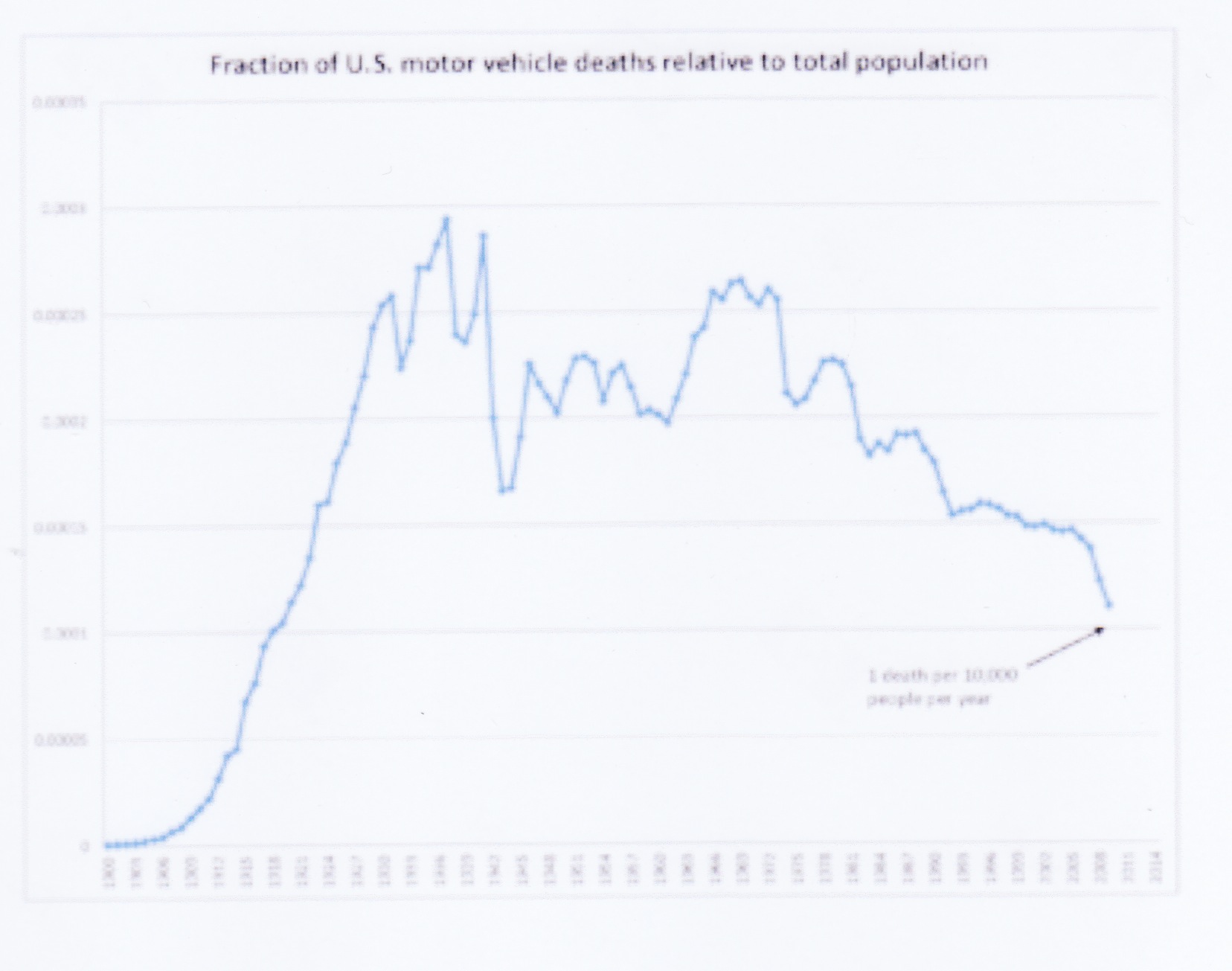
If you are not convinced, look at the following chart, which shows a decrease in traffic deaths of over 12% per year for the last 20 years. Although even one traffic death is too many, this improvement in the percentage of fatalities per capita is worth appreciating. We are now at the same level as 1918 when cars were barely able to go 30 miles per hour, roads were worse, and there were so many fewer cars to get in each others’ way.
Also, as I’ve gotten older and my memory more faulty, I appreciate the aid of a GPS that can alert me to gas stations, my favorite trout streams in the middle of nowhere, and an approximate arrival time that more than once has saved my marriage. My wife may occasionally curse such an electronic device, but when she does, she is not angry at me, and the avatar known as Allison on our GPS never takes it personally. For one who has learned that the gas station or the left turn by the big oak tree that most certainly is just over the hill, only it is NOT just over the next hill, and it is not even on this same road, the reassurance of Allison is a kindness to be appreciated. Besides, I imagine that Allison – by her voice – is a sexy, slender, long-haired, dark-eyed – well, you can imagine the rest. The British version named Emily on our first GPS may have been even more irresistible, but her occasional un-American propriety in words such as “Take the off-romp,” or “Turn wrought on Smythe Bool-vahrd” led to several dangerous misunderstandings. I had to un-friend Emily. That’s a good thing because Allison is so much better at her job than Emily was.
So many things are getting better. When I was a kid in my Huckleberry Finn little town, even the best bike had only one gear and a coaster brake. We made it better by hanging plastic tassels off the end of our handlebars and clothes-pinning baseball cards to the frame so their flapping through the spokes made the bike sound like a Vespa. As good as those improvements were, they do not compare with the wonderful preponderance of multiple gears on most bikes today, and even more important, the nearly universal use of bike helmets, which have saved the brains of many reckless boys and saved the faces and brains of many beautiful girls. These wonderful improvements took place in only one generation.
Even those among us who may be described by my daughter as “digital immigrants,” rather than “digital natives,” must appreciate the improvements in technology. Who among you remembers the days of the typewriter, White-out, backspace corrections, and the ultimate frustration of typing a research paper the night before it was due and noticing that on page seven you forgot to leave room at the bottom for two footnotes required for your quotations (found by luck amid the stacks of books and quoted on 3 by 5 index cards), and would have to type the whole page over. Do you remember the first mobile bag phones that were the size of a shoe box and worked only in metropolitan areas at a charge of about a dollar a minute?
Just last week, while we were in Marietta, Georgia for a wedding during the first mid-November blast of an Arctic Vortex (yes, it’s now an official name, so I’ve capitalized it), I wondered how bad the snow was back in Madison, Wisconsin, and with just a few clicks on my phone and access to local traffic cameras at major intersections in real time, I could see that on University Avenue, just three blocks from my house, the streets were wet but clear and there was about an inch of snow on the curbs and grass.
Do you want to know what is new and what you can do with new technology? Go to one of my favorite websites – Appsgonefree – and see a listing of a dozen or so apps free to download that day and keep forever. Many are silly games, but I’ve also downloaded guitar tuners, emoji keyboards, a dozen games for toddlers, including a favorite Trainzdriver, meditation sounds, timers, bicycle navigation, storybooks, crossword puzzles, piano keyboards for an Ipad, photo editing apps, weather sources with radar, Dropbox to share and save files, a library search engine, a PdF reader, and foreign language games. Those apps were all free. My phone is so much smarter than I am.
The betterment of the world is not just in technology, though. Populations grow because more people are surviving and having children. Children are better educated than they have ever been. (Do not believe the current fad of testing by the for-profit bean-counters. No school or student can nor should be judged on the basis of a 59-question multiple choice test like the ACT. Look at what happened to the few colleges who took the ACT as its only entrance criteria, and then found they lost entire classes of high-scoring but unsuccessful students.) Your kids not only know different things than you; they know more. Just to start, they know how to use a DVR and streaming capabilities. Give me a choice to play any game, including Trivial Pursuit, with a young person with a smart phone as a partner or a education-baiting pundit with a smart phone, and I will choose the young person every time…. and I will win. They know how to find information – useful information – when they need it, while the typical over-40 is still fumbling with fat fingers to turn on Google and then mis-type vague questions.
What else is better? You now can choose to eat organically, instead of the typical “food product” of Velveeta (read “not cheese”), Tang, (read “not orange juice”). Now we even excellent craft beers almost anywhere in the country. Doctors today know more and are better trained than those of only a generation or two ago. Cataract surgery is now done in fifteen minutes to outpatients. Buildings are safer. Clothes are more comfortable. (Do any men still wear starched shirts or women – whalebone or metal-braced corsets?) Weather prediction is more accurate (okay, I’ll admit the difference may be marginal, but you can now check your own isobars and radar to make your own predictions).
The flu, which once killed millions, can now be mostly prevented with a yearly vaccination. Now I’m back to where I started.
It’s time to take a leap, or at least to make a meaningful observation. I quit watching most news programs because their mission of providing a “story” almost always means reporting bad news, some disaster, or violence. Almost always it is mere fear-mongering. Good news is not news. Here’s my observation, and it’s risky enough, but probably true enough that I’m going to “bold” it.
In recent times, with the exception of war, most disasters are limited in scope, not pandemic, and truly affect a relatively small number of people, while improvements have been large in scope and affect millions. Even more important, nearly all disasters are temporary, while advancements like seatbelts are permanent.
I’m not denying that a global economy effects almost everyone, but even the economic meltdown of eight years ago was temporary, and now jobless reports show we’re almost back the where we were, and the stock market has advanced far above what it was. There will be regular crashes, probably for every generation, just like there will probably be more wars, one per generation, but the slow general trend upward for 20 of the 25 years per generation has continued for a long time. Humans are resourceful enough to keep that going, even as we fight localized ebola, ISIS, hurricanes, and blizzards.
Be patient, keep solving local problems; ignore fear-mongering news, and ride the wave along with me. Put on your bicycle helmet. Carry a towel if you must. We’re going up.
 kurthaberl