This blog is about retirement (or not) and why it’s important to say, “Okay.”
I retired four or five years ago after 36 years of teaching English and serving as a department chair. Once you retire, the passage of time changes, so you don’t care to remember whether it was four or five years ago. As one of my good friends and an art teacher, John, told me when he retired two or three years before I did, “Kurt, the main thing to remember in retirement is that the big paper arrives on Sunday.” That has been helpful in keeping time straight.
Two or three years ago I went back to work, sort of. Because of the way the wonderful state of Illinois deals with its teachers, I was short four quarters of Social Security credit, and my 36 years of teaching did not count. Any Social Security benefits did not matter because anything I collected there would be taken from my teacher’s retirement dollar for dollar to avoid “double-dipping” and make sure I didn’t get an undeserved $200 per month for dental insurance. What DID matter is that I did not have enough quarters to qualify for Medicare, and according to the Illinois retirement plan, you MUST qualify for Medicare somehow because they will no longer allow you to be a part of their medical plan once you reach 65. One’s work as a teacher in Illinois does not qualify for Medicare. Have you read Catch 22? That’s the short version. The long version is more about Illinois not wanting anyone to retire, so they just ignored all retirement plans for about 20 years as a way of balancing the budget and then used the money that teachers themselves contributed as collateral to borrow more for their pet projects and their own legislative and executive retirement plans. It doesn’t make sense, because in Illinois, governors don’t usually get a retirement plan payment; after some odd number of years in office, they usually get six to twelve years in some Wisconsin minimum security prison.
I could have been a substitute up here in Wisconsin and contributed to the upkeep or incarceration of some former Illinois governor, but I was really looking for something different. It turned out to be quite different, and quite eye-opening.
I heard about a local software company that was growing by leaps and bounds, and I applied online because I heard they hired teachers to train clients in their software. It turned out they only hired full-time teachers who were also called on to travel and trouble-shoot. They said they had their own part-time temp workers who might be asked to help out anywhere in the company from horticulture (the campus is beautiful) to administration (someone has to look at resumes) or culinary (their chefs and cooks serve at least 4,000 gourmet meals to staff and customers every day). Was I interested in temp work?
I said, “Okay,” just so I wouldn’t have to take papers home to correct, or meet with angry parents to tell them their son will not graduate in two weeks, and no, he cannot just walk across the stage to please Auntie Mame and finish his course requirements sometime in the summer (or never).
A month later this corporation called and said a woman in the kitchen had slipped on ice and broken a bone. Would I be willing to brew coffee in 35-cup hot pots for a month or five weeks? I said, “Okay.”
In two days it became routine to brew 50 hot pots for their meeting rooms and lounges, stop for lunch, joke with the other culinary people, clean up and go home. No papers, no angry parents. In five weeks I retired again, now only three quarters short of Medicare credit. It was good because the amount of rich coffee I was ingesting made me a little j-j-jittery.
A month later they called again. The husband of the woman who broke her ankle had gone for a physical and needed an immediate triple bypass. Would I help in the kitchen? I said, “Okay.” For the next six weeks, I helped set up a salad buffet and learned from the chefs how to hold a knife, chop and wash five cases of lettuce in the shortest time possible, dice onions without contributing any of my own blood, and mix salad dressings in five-gallon buckets. At one point, a chef noted I was getting better at using a chef’s knife and I said, “Thanks, but if I tried to go as fast as you, I’d lose a finger.” The chef said, “Well, Kurt, then you could be a cook for ten days.”
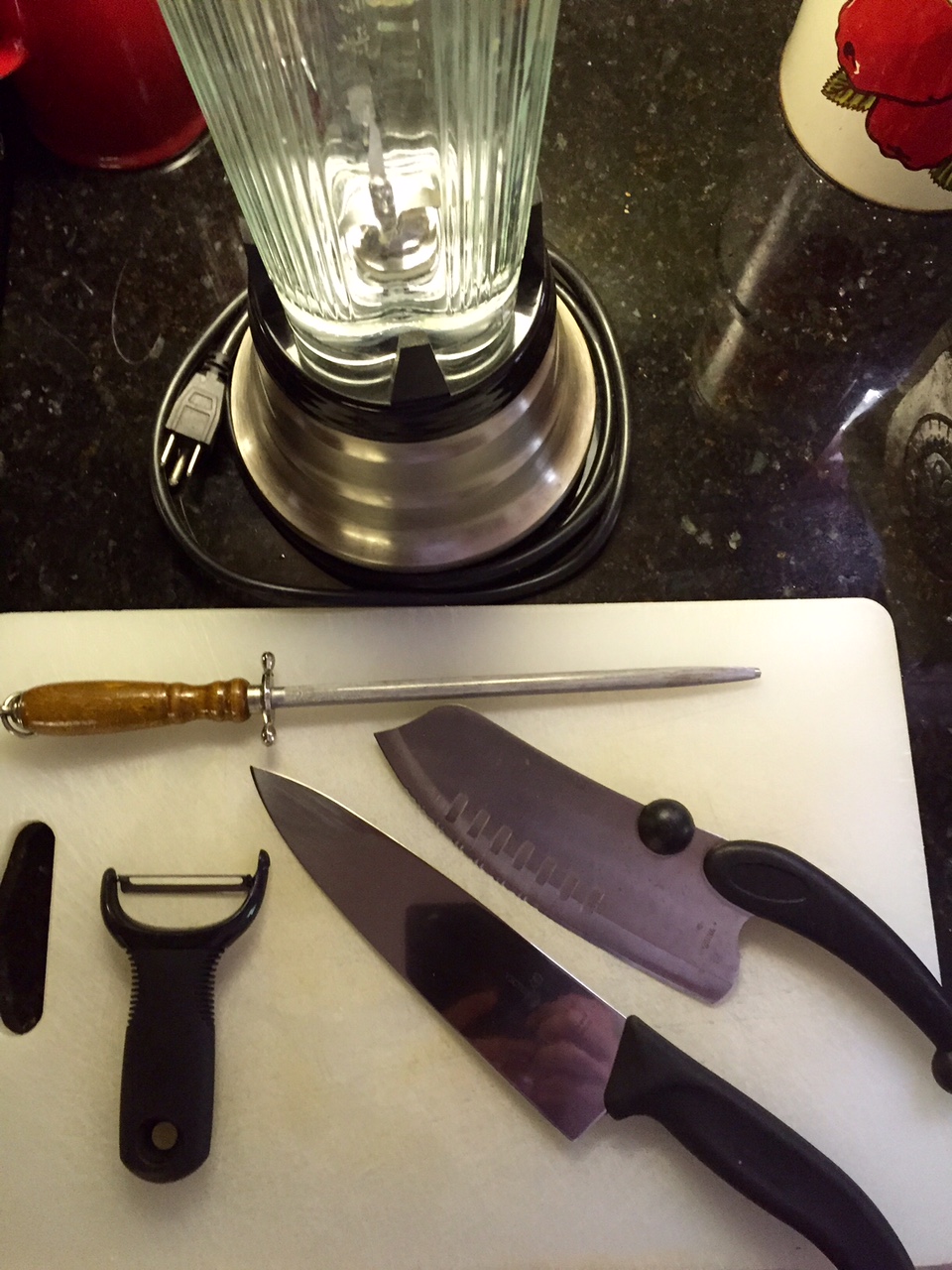
I was learning a lot. Don’t walk behind a chef without saying, “Behind!” I never knew if I was talking about theirs or my own. If you are walking with a chef’s knife, be sure to hold it straight down and call out, “Sharp!” any time you’re near someone. If you’re carrying a pot of soup, be sure to call out “Hot! Hot!” every couple of steps. The efficiency of a kitchen is amazing. Chefs work hard; they know what they’re doing, and when they’re finished with one project or are waiting for soup to simmer, they help someone else.
At one point I was asked to make a seasoning “rub” for 25 cases of chicken breasts. They gave me a Lexan mixing tub about the size of a coffin and a list of ingredients that began with 12 1/2 pounds of paprika, 4 1/2 pounds of ground black pepper, 2 pounds of salt, and so on. Mixing was done with plastic gloves that covered my arms up to my elbows. When I thought I was finished, I asked one of the chefs to check it. He didn’t taste it. He looked at the color and said, “Add another half pound of paprika.” They don’t measure much. Sometimes they taste and sometimes they just look at a batch and say, “It doesn’t look right. Add some more brown sugar.” Recently another temp mixed five gallons of Caesar dressing, and three chefs gathered to taste it. Soon they began to argue about what it lacked. Finally, the head chef tasted it and said, “Ooh, this is really good. It’s not Caesar dressing, but it’s really good. Go with it.” Everyone was happy.
On another occasion, the 35 gallon plastic drum we used to spin washed lettuce jammed, and one of the cooks took the top off to un-jam the spinner, but forgot to turn it off first. At that point, the drum ran free and instantly began to spin at top speed, throwing chopped Romaine around the kitchen, pelting everyone with wet lettuce. A lettuce food fight ensued, with the hapless cook the target of most throws. It wasn’t really a food fight; it was more of helping to clean up by throwing all the lettuce back to one central location marked by the cook who took off the top of the spinner. The head chef was not present at the time.
A year or two ago, (I’m not sure when… whatever, the big paper comes on Sunday), I earned enough credits to qualify for Medicare, but I have continued to work in the kitchen two or three months a year because I was learning how to cut and cook from experts, and because it was fun. More important than any pay was the perk of being able to bring home leftovers that could not be saved or re-used. That often includes fresh fruit salad, Caesar salad, and once, roast pheasant, roasted red potatoes and marinated asparagus. They’ve had leftover deep-fried bluegill, creamed soups, every kind of pasta imaginable, and desserts that won’t keep. It’s always good to earn “points” with your wife. Bringing home leftovers that would otherwise spoil is a lot more fun than bringing home papers to correct.
Although I’ve joked about putting on ten pounds every month I work, I’ve also gotten a lot of good exercise. The Fitbit my son and his wife bought for me says I’ve been walking an average of six miles per day when I work in the kitchen.
What is this experience really like? Watch a segment of Downton Abbey when the cooks are working in the scullery, and you’ll get an idea. Now imagine you’re cooking for several thousand people; the soup vats hold fifty gallons each; the menu lists a choice of three entrees per day and 400 of each entree is prepared, and a typical fruit salad prep will include six pineapples (sliced a certain way), three watermelons, a case of grapes (about a dozen packages to be hand-picked), a case of strawberries, and a couple of honeydew melons chopped in one-inch cubes. Now imagine that the kitchen I’m in is only one of five that may be prepping at full capacity that day. Most amazing of all, I’ve heard that the food in our dining halls is free to the staff; they pay only our salaries and costs of preparing. A typical grilled salmon dinner with rice and a vegetable would cost $5.00. A marinated flank steak dinner with mashed potatoes and roasted vegetables might be $6.00. At least 40 choices are available at our salad bar, and full square plate piled high is $3.50. This is not your typical corporate cafeteria.
The chefs and cooks have been lured away from Madison’s top restaurants by offers of regular daily hours, insurance, a retirement plan, and no night work, holiday work, or weekends. I’m learning from the best. Ah, retirement! I just retired again Friday. Time to go trout fishing.
One final thing I’ve learned…. I have great respect for anyone in the culinary segment of the workforce. A tip from me in any restaurant is now 20% minimum, usually 25%, and worth every penny. These are hard-working, highly-skilled people, and all the ones I know still have ten fingers. That’s is quite a feat. They deserve an extra dollar or two. I’d rather support them than an Illinois governor in some minimum security – you get the idea.
 kurthaberl
Loved your perspective on your work. Happy Retirement! Hope the fish are biting.
Very good .SHARP!.. i remember the pains in my legs and other places after working 14 hours Friday then again on Saturday and again on Sunday as a buss boy when i lied about my age said i was 14 when i was just 12 back in 1964 so I could buy my first set of drums. I m just saying. Medicare didn’t start till 1965. and i still won’t get it for another year and a half. The saddest part about the commentary is that it is all true. yet i still enjoyed reading it Thank YOu Kurt.. yours ej
After reading “A Life After Retirement” I think you’re a chef in denial or a warden want-a-be. We took a bus tour of Yellowstone National Park and the driver asked our small group to introduce ourselves and where we were from. When I announced I was from IL, “the state with the best politicians money can buy” I almost got a standing ovation.
Up as the WFSC and the fishing is really s l o w. Very low and warm water. I wouldn’t be surprised if they close the season early unless there is some signifiant rain fall soon.
Gordon Rudd
>
Okay, the part on moving to Madison was good….but your experiences at Epic are well and truly amusing. Had a good laugh at the lettuce barrel. Nicely done views on society, a blog that I shall certainly keep up with.
Thought I had left a reply on your moving to Madison, but one day in my early attempts to navigate this flaming city by Moped, without realizing it I turned the wrong way on Johnson Street. I could NOT figure out why everyone was honking and gesturing at me. That is until a Metro Bus pulled diagonally across the road, both to stop me, and to also stop other motorists from continuing to have an opportunity to kill and idiot. Knew Madison was a truly nice place with the driver calmly let me know that I was going the wrong way on a big street and needed to pay attention. In Chicago, the bus driver would likely have tossed his coffee at me.