For the Love of Taxes

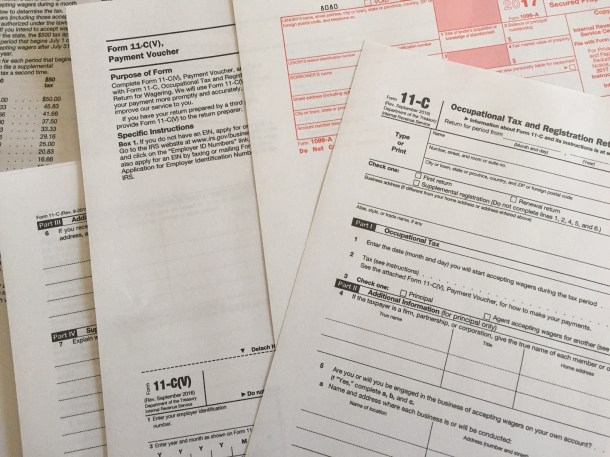
Let’s start with a little sarcasm. This is my favorite time of year – lots of slush, no fishing yet, and everyone is crabby (except me). This is also the time for two of my favorite things – filling out senseless forms that usually have numbers and letters on top like 1099-R (which makes me wonder if it took 1,098 earlier versions to get to this gem), and doing math. I love doing math. It’s so … Pythagorean. (End of sarcasm)
IMG_2128 copy

The stupidity of this process by which we fund our government is mind boggling, and after we do fund it, we have no say on where the money goes, not even if it’s for somebody’s golf vacation. Couldn’t I at least have a tax deduction for the amount I spend on fishing equipment every year? I mean, it stimulates the economy; it’s good for my health; it helps the ecology of the country, and it occasionally provides subsistence. Win-win-win-win. Also, I’ve done a search through the entire tax code and there isn’t a single deduction for chocolate. What are they thinking? You can’t deduct the amount you spend on the food of the gods?

I think we’re doing this deduction thing all wrong. I mean that progressive taxes, and some unreadable code for what can be deducted that is written by and for lawyers – just doesn’t cut it. I suggest that we each get to choose a deduction, the one thing we care about the most. If you have kids, you should be able to deduct what it cost to raise them that year, not some measly $1800 for a kid, but the actual money you lost, I mean invested that year in your kids. Then the deduction list could go mostly by age. If you’re in college and your parents are mostly paying for it, then you would get to deduct the entire amount you spent that year on pizza. Doesn’t that make sense? If you’re a musician, your deduction could be musical instruments that year. If you’re a cook, it could be knives and band-aids. If you’re a stay-at-home mom, it should be the total cost of aspirin, paper towels, a van, gas, diapers, in addition to whatever else that kid cost you. Think of the benefits. You’d be happier knowing you got a tax break for something you really care about; you would stimulate the economy by spending more on the things you care about, and the government could easily track “Here’s what people really care about.” Then, as usual, after you take your deduction, the government would tax everything else. It’s a beautiful thing.

Okay, I know what you’re thinking, so I’m going to re-boot.

So it’s tax time, the funniest time of the year, the time when the insanity of humanity reaches a crescendo, and the most hilarious part is that none of it matters. Allow me to explain, or better yet, to illustrate my point with two parental stories.

The first story happened quite a few years ago when we were visiting a parent whose identity will be disguised because I still appreciate Christmas presents, and while we were there, I heard a string of nasty words that ran from personal insult to pure blasphemy. I thought this parent was having a heart attack, so I hurried into the dining room and saw this parent pressing both sides of this parent’s head with his/her palms in a gesture much like that in Dickens’s Great Expectations when another esteemed parent with too many children regularly pressed his own head as if he could lift himself off the ground by locking his head and hair in his hands and lifting. Before the red-faced, steaming parent were stacks of forms spread out on the dining room table, a large calculator, and a pile of crumpled yellow legal sheets.

“Are you okay?” I said, innocently.

“It just isn’t working out,” the esteemed parent said. “I filled in the bottom line with how much money I want to get back like I do every year, and then I work backwards to fill in the spaces to get to that amount, but – It. Just. Isn’t. Working.”

“Wait,” I said, “You write in your refund first and then just fill in whatever numbers get you to that refund? How can you do that?”

“I don’t just fill in just any numbers. That’s illegal. I look at my receipts and records and estimate. Sometimes I round things up or down. Once in a while I have to put something in a different pile. I do it every year. It’s the only fair way to do taxes. If you don’t, the government gets all your money and spends it on thousand-dollar pens that will write in outer space or some study on the sex habits of fruit flies. Besides, this is real money to me. To the government it’s just peanuts.”

“Huh?”

“Fruit flies. They’re wasting my money on fruit flies.”

“I don’t think that’s what an actual study was about. I mean, they may have been using fruit flies-”

“Of course it was. Fruit flies. Are you telling me you don’t fill in your refund and work back from there?”

“Um, no,” I said.

The esteemed parent just shook his/her head at me with such a look of pity bordering on disdain that I could do nothing but slink away. It was no fun to do taxes that year.

I visited another parent recently to help out, but before we got to the subject of taxes, this parent asked me to look at their checkbook.

“The spaces are so small, I can’t write in the numbers for reconciliation, and I can never get that darned computer to work.” I was shown a large-button calculator that apparently ran on solar power, and I could see how that might be a problem if this parent worked on banking after 4 PM, especially in the kitchen where this parent once surprised me after I moved a chair to stand on because one of four ceiling fan lights was out, and I unscrewed the burnt-out bulb and this esteemed parent stopped me by saying, “Oh, that’s not burnt out. I unscrewed it because it was just shining on the refrigerator and we don’t need to light the refrigerator.”

“Huh?” I guess I say that a lot when I visit parents.

“Just leave it. The refrigerator has its own light when you open the door. It’s modern.”

So I turned on the three of four ceiling fan lights on this last visit to be sure the calculator had enough power to run, but the esteemed parent said, “Don’t use that computer. When I use it to subtract, it always comes out with less than I expect. There’s something wrong with it.”

“Okay,” I said. “I’ll use the calculator on my phone.”

“You have a computer in your phone?”

“Yes. These modern phones are mini-computers in a way.”

“Well, I hope the numbers come out right. How does it know you’re not just dialing someone up when you punch in numbers? I mean, you could be calling China, and then the Chinese will take all your money by reversing the charges.”

“My phone just knows. It has separate compartments for different sets of numbers so I don’t call China by mistake.”

“That’s amazing.” The esteemed parent shook his/her head in genuine admiration.

So I looked at the checkbook and pointed out that if the lines were too small to write in numbers, it would be okay to use two lines at once and no one would care.

“I don’t think I could do that,” the esteemed parent said. “It wouldn’t feel right to go outside the lines. It would just be – messy.”

“Okay,” I said, “messy is not good,” and then looked at the bank statement, noticing right away that the balances didn’t match. This bank statement included mini pictures of each of the checks written that month, but when I looked at the checkbook, none of those checks had been recorded.

“Um, you didn’t record any of the checks you wrote this month in the checkbook,” I said innocently.

“Oh, you don’t have to worry about that. There’s plenty of money in our account. The bank can figure that out.”

“But you don’t really know how much you have. You can’t just keep writing checks and not record them in your checkbook.”

“Well, sometimes I do. It’s just that the lines are so small. All I really need is an estimate. Just estimate those checks and put that one amount in the checkbook. It will be fine. If there’s a problem, Linda will call me.”

“Linda?”

“She’s my friend who works at the bank. When they’re busy I just wait until I can see Linda. She’s really sweet and has three children, even though she’s just a young girl, so she has to work, I mean her husband works, but not very hard, and she fixes things when I go to the bank, and she never forgets to ask if I want a lollipop.” What followed was ancestral information on Linda’s forebears, who she was “from home,” and why the only banker in town worth seeing was Linda.

“But what if you go to the bank and Linda’s not there?”

“Well, then I just pretend I forgot something and come back another day. You can do that when you’re old and retired.”

After that, I did my best to record their checks, (in pencil, just in case), compare the balances, and then add a line for reconciliation to put an extra $14.27 into their account because the bank said they had that much, but for the life of me, I couldn’t figure out where it came from. I suspected that six months ago, someone used the large-button computer without turning on the three lights in the ceiling fan and for once, the result of some subtraction that came out as expected, if incorrect.

“See, the balances match,” I said proudly.

“How did you do that?”

I started to explain, thought better of it, and said instead, “The calculator on my phone has always been accurate. If anyone else helps you, Linda or anyone in the family, be sure they know I did the balances in pencil on purpose, and I’ve recorded all the checks in the last statement.”

“You really don’t have to do that.” What followed was another encomium on the wonders of Linda.

After working on their banking, this esteemed parent said, “That’s enough for one day. I’ll have your sister help me with the taxes when she comes out. I just put in the same numbers every year anyway.”

“You do what?”

“We’re retired, so the numbers don’t change much. I just copy the numbers from the previous year. If anything changes, I put that in, but for the last couple of years the numbers are close enough.”

“Huh?” I said.

“The numbers. They’re always pretty much the same. The only problem is that the spaces are so small that I can’t write them in the boxes anymore, so I’ll just have your sister do it when she comes out next week. One time the government sent a paper saying I added wrong, which was ridiculous. I didn’t add at all because the computer is always wrong, I just copied what we had from the previous year, and the paper said we owed them 24 more dollars, so the refund they sent was $24 less than what we were supposed to get back. I thought of calling them up to complain, but I figured it wasn’t worth the trouble, so I just let it go. You have to watch the government, though. They’ll cheat you if they can. Most people probably wouldn’t even notice. I’m not worried because last year they sent us the right amount for our refund like in the previous years, so I figure there was just some new person who didn’t know when they got our tax forms that year.”

“And Linda doesn’t work for the government,” I said.

“Exactly,” my esteemed parent said.

Some day, I think I’m going to go up to the bank and give Linda a present. She’s earned it.



Cabin Fever


img_1508

I wonder whose terrible idea it was to put 31 days in December and January. That god probably felt so guilty that he decided to ease up a bit with 28 in February. Our calendar is all wrong. December, January, and February ought to have about fifteen days in each of them. May and October, our prettiest, most temperate months, ought to be 45 days long, maybe 50. This morning when I looked at the calendar, I thought, “This is terrible. You mean it’s only January 13th? Really?” Don’t get me wrong; I like four seasons; it’s just that the witchy-ness of winter ought to last for just a few weeks, along with the sauna heat of August. Two weeks – that’s enough. Change is good. I’ve spent several weeks in San Diego, not to disparage California, but every day was the same – humid and foggy in the morning with the mist burned off by the sun at exactly 10:15 AM, then partly cloudy with a slight breeze for the rest of the day, followed by a calm, humid night. Every day. It was like – eating chocolate for every meal. I love the 4 1/2 pounds of dark chocolate my kids gave me for Christmas, but if that’s all I had for every meal, I’d go on a hunger strike after only two weeks. Okay, maybe two months. It is pretty good chocolate.

Two or three weeks of just about anything ought to be enough. We could have two weeks of winter in January, then two weeks of Octobuary, then maybe two weeks of early spring, then two more weeks of January, then Maybruary, and so on. You get the idea.

It’s not just the weather. Cabin fever means I’m really tired of looking at the same crack in the concrete of our porch every time I go in or out. Someone should fix that. It’s like the Newel post cap that Jimmy Stewart grabs every time he goes up the stairs in It’s a Wonderful Life. That brings up another problem. I love that movie, but every winter it has the same ending. Why the hell doesn’t someone fix it in version B so Potter gets caught with the $8000 he stole from Uncle Billy and is sent to jail where he goes crazy because he can’t control everything, and his unclaimed millions go to the state, and they use it to build more houses and a hill for sledding that doesn’t end in a pool of frigid water that could make a boy deaf? They could even afford to have sleds or toboggans available instead of those rusty old coal shovels. I also wonder why a little town like Bedford Falls can afford a high school gym with a movable floor over a swimming pool (and this was back in the days of black and white film), and they can’t plow their streets when it snows, and cars slide off into stately, old trees. Is that crazy or is it me? Cabin fever is a terrible thing.

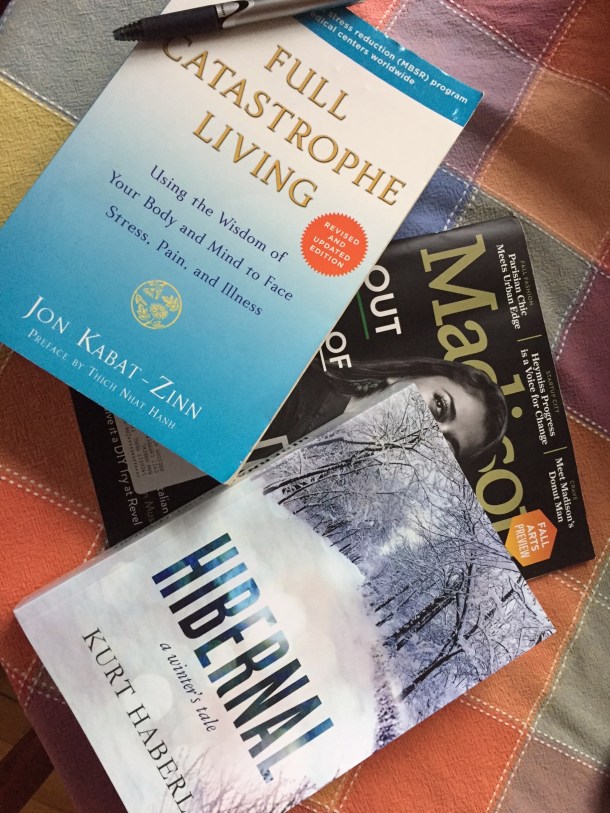
Books help a little. Thank you, Emily Dickinson, for reminding us that there is no frigate like a book to take us lands away, especially if you have a little fire in the fireplace, a cup of hot tea, some chocolate and Pentatonix harmonizing quietly in the background.

img_1512

The problem is that reading is like meditation – you can do it for an hour or so, but eventually it feels like solitary confinement. It’s all in your head. Then something else needs to happen – maybe a mousetrap to snap up in the attic, or a smoke alarm battery to run down and begin to chirp so you rush around the house to check for a fire, or maybe even a fluorescent under-the-cabinet light in the kitchen to pass its ten-year life and begin to flicker. Something needs to happen. Anything. Cabin fever calls with irking insistence.

Some days I walk to the nearby Crescendo Coffee and Music Bar, but even getting out that way becomes a problem. My Fitbit tells me it is exactly 3892 steps, counting the puddle on Edgemont Avenue I have to sidestep and stopping to talk to the crossing guard at the corner of Allen and Eton Ridge. It’s like being in the movie, The Truman Show, only I don’t have a boat. It’s all so predictable that I swear I’d even be willing to do something different like finish painting the trim outside our house if the paint wouldn’t freeze on the brush. That’s how desperate I am. Cabin fever is terrible.

That’s when the worst thing possible happens. My loving wife looks at me with great pity and says, “Maybe you need a job. Get out and meet more people.”

I love winter. Really I don’t care if it lasts for four months. There’s nothing better than hanging out in a cozy house. You can light a fire in the fireplace and eat a piece of chocolate – whenever you want. It’s great to recharge the batteries, to plan for the first trout fishing trip in the spring, to watch the birds fighting over seeds in the feeder you just filled, to wave at the mailman who dropped off some interesting bills today, to look at the sky and appreciate the fact that it’s not the same sky that appeared yesterday. Winter is a blessed month. It’s got Christmas and Hanukkah and Kwanzaa and Festivus-for-the-Rest-of-Us in it. I mean, what’s more exciting than putting up that aluminum pole before the airing of grievances followed by feats of strength?

If you’re one of those poor unfortunates, especially retirees, who suffer from cabin fever, just remember there is a remedy that works every time. All you need is for your wife to give you that look of pity and tell you to get a job and meet new people. Poof! Cabin fever gone – cured – defeated – boxed up and carted past that loose Newel post cap into the attic with that fantastic, beautifully-designed mouse trap protecting your house. Winter may be the best season of the year. I love it. I really do.

A Mind Is a Dangerous Thing

Last week I went to the dentist for a regular tooth cleaning (Tooth – I barely have one or two. The rest are caps, crowns, enamel things they put over posts, pins, I-beam structures, and root canal platings. My mouth is a record of the development of historical dental practices, most of which have now been abandoned.) A dental cleaning, for those of you who have good teeth or are in denial, is a practice like mini-waterboarding. It usually involves gagging on water washes, gum poking with sharp instruments, a whole lexicon of sighs and sudden breath catches by the hygienist, and gritty polishing using Chicago beach sand intended to taste like mint – the grinding administered by an impressive little drill that looks like a ball-point pen but feels like Ryobi four-horsepower metal drill with a 1/4″ dulled bit last used to erect the St. Louis Arch.

I found out they have a new instrument of torture called a Cavitron, which shoots larger amounts of water than what is used in waterboarding and somehow administers a painful electric nerve stimulation at the same time. Its purpose is ostensibly to remove coffee and tea stains from derelict drinkers like me, but it mostly is designed to convince victims that their dentists and hygienists REALLY want them to stop drinking coffee and tea. It convinced me for an entire day (yesterday) that I would never again drink coffee or tea. The Cavitron is a perfectly-named hand-held prod.

I’m writing this in Crescendo, which is a coffee house on Monroe Street in Madison. My friend, Earl Gray, is at the table with me. Take THAT – Cavitron. As you may guess, I don’t go back for another tooth cleaning for six months. I suspect that by then, the Cavitron will have morphed into a Mega-Stripmine-Tron.

Actually, I’m not going to write about the dentist; that was just a prelude. I’m going to write about my mind because of something else that happened at the dentist’s office, so forget about the Cavitron.

Before the actual waterboarding started, the hygienist put a little strappy thing around my wrist, which I thought she would then attach to the padded armrest before strapping down my other wrist. Instead she said, we’re helping to screen people. I’m just taking your blood pressure. In less than a minute, her breath caught, and she showed me the numbers, 150 over 95.

“Are you taking anything for high blood pressure?”

“No,” I said. “Until now, it’s been normal. I had a physical a year ago and when the nurse checked me, it was a little high, but after the prostate exam was over, it went back to normal. My doctor said that was not unusual.”

“Well, you should see him again. High blood pressure can be ………..(Insert a looooong pause) a problem.”

Then she began the waterboarding, which was probably easier than normal for me because all I could think about was high blood pressure, how her breath caught, and how long her pause was. Since I’m usually a calm, rational guy, that wrist reading couldn’t possibly have resulted from knowing I was about to be waterboarded, poked with sharp instruments, and Cavitronned. To make matters worse, I couldn’t remember the numbers for a normal blood pressure, the numbers that indicated medication, or the numbers that meant – go to the hospital right now for a stress test. (As if going to the hospital itself wasn’t a stress test).

After the waterboarding and Cavitronation was over, I stumbled out to my car, managed to make it home without driving over any islands, cyclists, construction barrels, or parkway trees. Immediately I called my doctor to make an appointment for another physical, the second recommended pneumonia shot for those over 65, and a BLOOD PRESSURE TEST. The earliest appointment was going to be over a month away. I panicked, explained the story of my blood pressure, and the scheduler asked if I should have a nurse call me back. A half an hour later, I had a nice talk with the nurse, garbled the numbers I tried to remember, and she kindly told me I probably had them reversed. Then she said the numbers were high but not dangerously so, and I could come in to check or go to a Walgreens and they would check me. Then she said, “You know, I don’t mean to insult you or your dentist, but we don’t have that much faith in a blood pressure check by a little wrist strap. Besides, going to the dentist is like-”

“Being waterboarded,” I said.

“Well,” she said. “I wouldn’t go that far.”

“Have you ever had a Cavitronation?” I asked.

“Um,” she said. “No. Look, if you’re worried, come in and we’ll just check your pressure. You can also help by cutting down on salt and caffeine. Are you overweight?”

“Maybe eight pounds.” I just made up that number. It’s probably ten or fifteen pounds.

“Well, get rid of those eight pounds. Walk more. You could have the whole issue taken care of before you come in for your physical. If not, just come in for a blood pressure check.”

That’s when I realized that there was a conspiracy between dentists and general practitioners to get people to stop drinking coffee and tea. My blood pressure panic was eased by a conspiracy theory. It works every time.

Okay, I thought, I can cut down on salt. When my wife came home, I told her the whole story. She seemed upset. That’s when she reminded me that I regularly made large bowls of hot, buttered, heavily salted popcorn. Her face looked sadly popcorn-deprived.

“Well, there are salt substitutes,” I said. “After all, popcorn is an essential food group.”

That seemed to ease her concern and she said, “You know, you could be like me and use just a little salt – just on popcorn and not on anything else.”

That’s when I started going through our refrigerator. It was not a good exploration. Tomato juice – 650 milligrams of salt. OMG. I had made a crockpot the day before of slow-cooked chicken and dumplings and looked at the cans of cream of celery and cream of chicken soup and chicken broth I had used. Their salty total made the tomato juice look like it was a health food rather than the salty poison I now knew it was.

Everything I looked at – OMG – salt and more salt. Butter, sauerkraut, salad dressing, chili I made with a base of salsa, OMG the salt in potato chips, bacon, and nuts.

“Well?” My wife said.

“It looks like the only things I can eat are lettuce and oatmeal.”

My wife is a smart person. She said, “You know, this isn’t about salt.”

“It isn’t?”

“No. You’ll go to the doctor and get checked and he’ll help you take care of the problem if there really is one. Until then, you should get out of this all-or-nothing loop.”

“How can I do that?”

“Well, you can start by making some popcorn tonight.You make the best popcorn. I have some shows I’d like to binge-watch and popcorn would be nice. I’ll salt yours, though.”

True love is a wondrous thing.


Husbands/ Book Club

So three male friends and I decided to start a Husbands’ Book Club. (I capitalized it to legitimize the concept, even though we’re not really a book club or not exactly a book club. Actually, not one at all.) It happened by accident. My wife is in two book clubs made up entirely of women, and in both cases, when the meetings rotate to various houses, husbands are not welcome. If you write a book and the women decide to read it, you get to attend that one meeting to answer questions about stuff in your book you never thought about and you’re not even sure was in your book, but that’s the only meeting you can attend. I could hang out upstairs and watch sports, I suppose, but when I talked to one of the other husbands, he said, “Let’s start our own book club.” He got two other husbands interested, and then said, “You know, Kurt, the women don’t just discuss books, they have a fancy meal.”
img_1981

We decided to rotate to all the best restaurants in Madison to discuss books, drink, and eat. It would be a financially reasonable night because our wives were not invited. On the first meeting we couldn’t decide on a book, and then thought it was too much work to read a book for a stupid meeting when we’d rather talk about cars, traveling, hunting, fishing, sports, and the general state of the world going to hell in a donkey cart. Someone suggested we become a magazine club, but even then, it sounded like too much work. To pick a magazine every month and read it, when all we really wanted to do was have a meeting to drink, eat, and tell stories – seemed like such a waste of time. We decided we were much more interesting and funny than any magazine anyway. It’s true.

One member is a retired history of science professor from the University of Wisconsin who knows tons of stuff about Galileo, the Vatican library, and lots of scientists I’ve never heard of. He does original research in Latin and speaks French, Italian, German, and passable Greek. I tried to read one of his books on science, but it had math in it, so that was the end of that. The second guy is a former engineer, inventor, and businessman who sold two of his businesses and now is a semi-retired professional photographer. He did some design of an optical machine used to test eyes and refraction, but when he explained it to me, his explanation had math in it, so that was the end of that. I can’t really tell you what he invented. The third member is a naturalist who worked forever for the Wisconsin DNR, fought for years to save Wisconsin’s beautiful ecology, and just retired. He fought a good fight, although now the greedy bastards who want to bottle spring water in headwaters where trout spawn, gouge open-pit lead mines, dig sand pits and supply frackers with whatever they want – have the upper hand. He’s sad and needed a book club like ours.

Then there’s me. In my career I read half of the classics I should have, but since I was an English teacher, I can just make stuff up, so I get to be part of the conversation. Besides, I came from Waterloo, Illinois, which in my youth had maybe 3,000 people in it, so I have stories about stuff that Faulkner turned into novels. We have a great time, even before we finish a single beer or glass of wine. We laugh uproariously, but so far have not been kicked out of any restaurant.

We suggested to our wives that they should do two books a month, but they said it would be too much for them to handle. Women can be such slackers sometimes.

Here’s what it’s like to be at one of our book club meetings. It’s deer season up here in Wisconsin, so last week, that was our first topic. Our science professor told about his experience last weekend when a deer came out of the woods about 30 yards from him, turned broadside and stood there waiting to be shot. He lined up his sights even though such a point-blank shot made the deer look like the proverbial broad side of a barn, then he pulled the trigger. The deer bounded off, and my friend spent the next three hours looking for blood or some sign to track the deer before he finally had to admit he had missed. All his knowledge about trajectories, vectors, the history of science, and ohmygod – math – did not help him, and somehow he missed the broad side of a barn. Even his expert Latin and passable Greek did not help. The other three of us were sympathetically dumbfounded, which led us to a discussion of refraction, gravity, astrology, horoscope signs, Nostradamus, and the effects of eclipses on primitive societies which caused the unthinkable to happen.

Next up was our ecologist who worked for the DNR. That same weekend, he had finished cleaning his rifle and drove with his wife out to the friend’s farm to hunt for at least a couple of hours before the light faded. As soon as he got out of the car, he saw a very large buck heading very slowly along a hedgerow. As quickly as he could, he lugged his gun case along a fence to intercept the deer and make the perfect shot. When he got to his spot, he got out his ammo, took his rifle out of its case, and with a sigh that can only result from a catastrophe, looked at his clean, oiled rifle, and realized he had left the bolt on the table back home. There was no way to load a shell, nor did he have a firing pin to shoot it. He looked at the enormous buck through his scope mounted on the top of his rifle, and pretended to shoot it four times. This led to another discussion of what a rifle actually needs to fire a shell, astrology, horoscope signs, the unthinkable, etc.

Quite naturally, this led to a discussion of cars we owned, and what parts were actually necessary for any car to run. This was a discussion in which the essentials are quite different for men and women, and since this was a men’s book club meeting, I didn’t have to re-tell my story about the time my wife and I were driving through the Chicago suburbs to see a Shakespeare play on Navy Pier, and the day was so hot that our old car overheated, but I managed to keep it going until we got to the parking garage by opening all the windows and turning the heater on full-blast to lower the engine temperature. It worked fine. I would have been in the clear, except that when we got out of the car, my wife noticed that the unbearable heat had melted the glue which kept her soles attached to the bottom of her shoes and she was now walking like a clown to see Hamlet. Flop, flop. You get the idea.

I had told this story at a previous book club meeting and received the most reasonable understanding from the other husbands, who voiced the proper response, which was, “You did exactly the right thing. That’s how cars work. Why did your wife buy such cheap shoes?”

If you are a husband and you travel somewhere near Madison, Wisconsin, the last week of any month, you might want to check with me about the time and place for our next Husbands’ Book Club meeting. If you appreciate good food and know some stories about Galileo, hunting, fishing, cars, sports, astrology, refraction, ecology, Latin, or traveling, you would be welcome. If you don’t know about those things but you majored in English, you could just make stuff up, and it would be okay.

Why It Is Important to Get Sick


It hit me Sunday over a week ago. I had been to the Wisconsin/Illinois football game the night before, a chilly, misty night, but because the Badgers won, that evening could have had nothing to do with my illness. Besides, I’ve read numerous studies that have said cold weather alone does not cause illness. Certainly everything I read on the internets must be true or Zuckerman or Bill Gates or Wikipedia volunteers or Anonymous would have it removed. Our two grandchildren were staying with us and at least one of them had a cold, but that couldn’t have been the source of my cold and sore throat because they’re so cute. I think my cold must have come from the girl who sold me a bratwurst at Camp Randall. It was a bad cold she sold me with that brat, a throat sting that made me resist swallowing, a balloon nose and damned dammed sinuses worse for me than for other people because my sinuses are so cavernous and encroach into areas where other people have brain matter. Coupled with the local symptoms was a tired, downer blah-ness like a car coasting to a stop on the side of the road because it had just run out of gas. You know the feeling.

There are people in the world who get ill and can best be cured by attention, pampering, and gentle face caresses accompanied by, “You poor dear.” Bonus points may be given for servings of chicken soup made from scratch, hot lemon-and-honey tea or runs to the drug store for aloe-suffused tissues, Dayquil, Nyquil, four kinds of cough drops, zinc pills, Mucinex, a Neti pot or two, Vicks Vaporub (remember your mother’s generous use of Vick’s Vaporub?), and various homeopathic remedies whose names I can’t even pronounce – but they all contain rare Tasmanian roots, berries from Tibet, and Extract of Supercalifragilisticexpealadocialshroom from the deepest caves of the Incan Andes. Me? I go to bed and demand to be left alone. Just me and my saline nasal spray. And maybe the Vicks.

img_1974

Several other things inevitably happen when one gets sick. The first and perhaps most important is that one achieves the Buddhist Nirvanic state of becoming a human being instead of a human doing. Drowsings, naps, and fading in and out of misery are punctuated by extensive periods of – nothing. You lie there with yourself, your sluggish thoughts, and a passing daydream or two. This is a truly wonderful time.

Sometimes a vision takes you anywhere but the time and place where you are. It is summer and you’re in the back yard where all the flowers are blooming at once and there’s a robin warming a nest for good luck in the oak tree, and it really is a good-luck robin because you saw that she already crapped on your neighbor’s car, not yours, and it’s the neighbor whose new patio flushes rainwater into your driveway. You tell the robin, “Good job.” There in the back yard in the summer, you’re sitting on a cushioned lawn chair reading some rough draft you wrote on your iPad when suddenly you get an update from Amazon’s CreateSpace that tells you ten more people just bought your book, and it looks like they appreciated it because it hasn’t been sent back and no one’s flamed you with a one-star rating.

Sometimes a vision takes you back to college – your classes are all going well and you just turned in the best research paper of your life. Suddenly you’re onstage at the Barrymore Theater, and the crowd hums with expectation. Then you pick up your brand new Gibson Les Paul with the tobacco sunburst finish and gold fittings – no, it’s a cranberry red Fender Stratocaster with a black pick guard and an ebony neck, and you plug it into your array of effects pedals and a Fender Twin Reverb tube amp with a tuned-and-ported custom external cabinet, and you begin to play – exactly like Eric Clapton – wild flurries of notes, and then you become Mark Knopfler, smooth and melodic, and able to finger-pick your strings like you had eight fingers on each hand. When you get tired of that, you switch to playing a portable Hammond organ with a Leslie speaker that spins slow and fast and slow again so the Doppler effect kicks in and out like the controlled tremolo of an opera singer. You’re surrounded by your buds, a bass player – yes, it’s Kevin Kelly – with a booming bottom line that throbs, and Tom Wild on his Telecaster, and – oh, man, my throat hurts. There’s a cough drop here somewhere. It doesn’t matter that half of the paper wrapping is somehow embedded into the cough drop. It will all dissolve eventually.

In a few minutes or maybe an hour – you can’t tell because time has become irrelevant – you choose to walk through a stand of tall pine trees carpeted by soft needles. A squirrel chatters away; birds you can’t see chirp at each other, and off to your left is a woodpecker knock, knock, knocking. You follow a faint path around a gentle rise and hear the gurgle of a riffle below a deep pool. There are trout in that pool, large rainbows and darting brookies, and you have a fly rod in your hand, a Sage 8-foot 4 weight, no, it’s a handmade Payne split cane rod worth thousands, and it casts your dry fly with the smooth silkiness of a Michael Jordan jump shot. – the one where he hung in the air for thirty seconds while Craig Ehlo flew by, and the shot floated….

I’m in that gym, only now instead of 5’10”, I am 6’5″ and quick as a cat, and some taller oaf tries to guard me, but my first step already sends me past him, and another guy appears and bangs into me, sending me into the stands in the corner, but I see the basket, so far off with the diameter of a mere frisbee, but I shoot and feel the shot, keeping my hand in the air because I can guide the ball even after it leaves my hand, and it sails in slow motion, and – swish – 3 points and we win. Then I remember I played so long ago that the 3-pointer wasn’t even part of the game back then.

Ow, I think I need another spray of saline solution, even though it burns when it goes down.

Someday I’m going to write about this.

Where was I? Oh, yeah, when I feel better, maybe by next spring, I’m going to get my bike out – I like my bike, the shock-loaded Trek with the two-tone root beer float finish – and I’m going to start on the trail along Lake Mendota – no, I’m going to head along the trail through the University of Wisconsin Arburetum where the breeze is always gentle and pushes you along as you head out of town – out into the rolling hills toward Verona and the little spring-fed streams that run into Kittleson Creek where I know there are trout, especially in the pool around the bend from the bridge, where the other, that nameless creek runs into it…and…the pool is…ah….

Is it still today? The light has changed. When this cold is over, I’m going to do everything: practice music for at least six hours a day; clean out the basement; build more raised beds out of 2 by 12’s for next summer, then maybe shake the rest of the pin oak leaves off the large tree in our back yard so I can rake them one last time. Then I’ll finish that non-fiction book I’ve been meaning to write on alternative Facts of Life; add more insulation to the attic; fix the screen door that has a little hole in it for next spring; move our compost bin closer to the garden and then travel to all those places I’ve seen on PBS, starting with the boat trip down the Danube or Rhine, or whatever river that is. It’s gonna’ be great…if I ever get over this cold and sore throat.

Where was I? Was that a minute ago or an hour ago? I guess it’s important to get sick once in a while. Everybody should get sick, and it should happen more often. I’m going to write about this someday.


What I Learned from Downton Abbey

1280x720_downtonabbey_s4_cast


Six years is a good run. It’s also an investment in fictional lives, a milieu, and the often unnamed things that matter. Botch the story, send the characters off into self-absorbed whining, or worse, bore your audience, and they quit watching. Keep viewers who watch until the end and then look at each other with an expression of, “I-wish-there-were-more,” and you have done well as a writer. Downton Abbey, I believed passed the ultimate test of literature – a presentation close enough to life without actually mirroring it so that it speaks to us. A private world is created and we are allowed to live in it. We learn. We take something with us after the experience. This blog is about that something.

Lesson one: More than money, social position, or even the possession of near absolute power that can raise up the lowly or cause the downfall of the unfortunate – Kindness rules. (Take that, you politicians today who practice various scorched earth policies.) Kindness is the ultimate currency that buys life and influence; it is the power that eventually beats all others. It is in a lady’s concern for the progress of a village hospital. It is in a lord’s concern for the quality of housing built on an estate to help fund the Abbey. It is in a daughter’s willingness to swallow her triumphant pride and call back her sister’s estranged lover because it is best for her sister. It is in the pat of the hand of a dowager who tells the lady who has taken over her position as president of the hospital that she is doing a wonderful job. Kindness marks the lives of servants who worry about each other, save their own from suicide, risk their own positions to testify in court, keep secrets or not depending on what they think is best for the other person. It marks the generosity of an earl’s American wife and later, a newly-married husband who put their entire fortunes at the disposal of the family and the estate.

The greatest kindness is the vein that opens even in the prick of meanness. Because of it, the dog-stealer, the rebel, the scandalous, war’s wounded, and the petty autocrats are redeemed. Kindness heals; it makes the broken whole; it makes the savage human and the unsophisticated better than the aristocrat. When in doubt – be kind – always. At this point I am led to a greater passage – Portia’s speech on mercy from The Merchant of Venice, which many of us had to memorize (with good reading). “The quality of mercy is not strained. It droppeth as the gentle rain from heaven on the place beneath. It is twice blessed. It blesseth him that gives and him that takes….” Part of the lesson from Downton Abbey is that when the people are not kind, things do not go well, not for their rivals or themselves. The story of the under-butler Barrows is the best illustration. He almost died because of his own meanness and was saved only by the last-moment concern of a lady’s maid.

Lesson two: Nothing lasts. One would think that a house, an estate, a title chiseled into a culture and layers of traditions over many generations would ensure the continuance of those things, but it is not so. One of the interesting things is that Americans, we title-less, disorganized, anything-goes Colonials could be so fascinated by a class system we do not want, barely understand, and would certainly resent if it were imposed in the States. After all, we’ve developed our own class system based on money, which anyone can join if he or she has enough, no matter how that wealth was amassed. The Kennedys, the Rockefellers, the Gettys, and even the Walton family come to mind. What many did to get their fortunes may or may not have been legal; much certainly was unethical, but they did not get caught, or if caught, they found an oily way out. Fortunes are lost, not always by blunders, theft, or revolution. A fortune is lost because it is almost inevitable. It may take several generations, but it may also happen because a comma, a minuscule serif, is inserted in a piece of otherwise well-meaning legislation. Big Oil is a recent example, but there are others. Do you still own Sears stock? Enron? Bell Telephone? American Motors? Zenith Electronics? Even those that still exist are poor step-children today, sometimes the scullery maids who must get up first to clean out ashes and stoke the fires for others. Some ruined their own prospects; some fell to changing economic conditions, and some were simply swallowed up by predators.

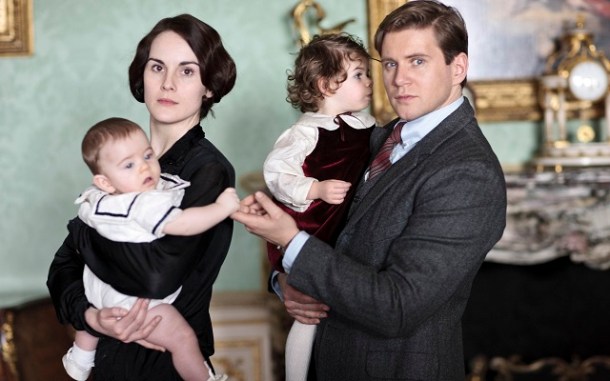
FIRST LOOK DOWNTON ABBEY SEREIS 4. Lady Mary played by Michelle Dockery with Baby George and Tom Branson played by Allen Leech with baby Sybbie COPYRIGHT: CARNIVAL/ITV

Even love may not last. It is interrupted by death, trouble, self-centeredness, pride, and faithless behavior. Love is a choice, and it must be re-chosen every day. We must tell our spouses. I choose you. I choose you. I choose you. Someone else may temporarily seem to be a better deal, but I choose you for the long term. Counselors tell us marriage is killed by disdain and the repeated eye roll. That means it is important we tell each other as often as possible: I choose you again. Designing maids may seduce lords. Ladies may be overly-appreciated by art historians. A visiting Turkish diplomat may die in a lady’s room. A chauffeur may marry a titled lady. We choose, and when we choose for the long term, things almost last. At least they last for long enough. At least they may last for a lifetime. What more could we ask?


Lesson three: No matter what our position, power, or personal integrity – we all just muddle though. In one of the most prescient titles of all time, Achebe’s novel Things Fall Apart reminds us all that Plan A is never enough. As Bobby Burns put it, “The best-laid schemes of mice an’ men gang aft a-gley.” In Downton Abbey we see the repeated near-bankruptcy of a privileged estate, a witness to other estates that failed, decayed, and became the mere ornament for the ultra-materialistic nouveaux-riches. Even the terms used to describe them are hyphenated.


images


In Downton Abbey, ovens break down the night of an extended family banquet; an old letter tossed into a fire nearly burns down the house; the joyful birth of a son is overshadowed by the death of the husband in a car crash, the same kind of accident that eventually sends Mary another husband. A child is born before Edith’s true love can marry her. An outsider, even worse, an Irish activist and mere chauffeur becomes the common-sense savior of the family estate. A bright, but naive daughter inherits a publishing company. A mere footman becomes an admired teacher who knows more than many graduates of Cambridge. All of this muddling, like struggles in any life, may seem impossible, but the older one gets, the more one has seen the impossible. A poor, black boy with an absent father becomes president. The presumptuously-named God-particle is found. A tiny wave in the time-space continuum is detected. Cancer cells may be “tagged” so one’s own immune system sees them as invaders and attack. Curiouser and curiouser. No one stays clean all the time. We rust. We sag. Our eyesight fades. Our memory gets more selective. It’s true of me, of you, of the famous, of the powerful, of the simple, of professors, of mothers who would give almost anything for a full night’s sleep, of fathers who don’t know where the next job will be, or the father who would give almost anything for a full night’s sleep, or the mother who doesn’t know where the next job will be. It’s all the same. We muddle through. We Muggle through. Magic may happen, but we have no wands.

The muddling makes us grow, and if it does not kill us, it makes us stronger. That is how LadyMary learns to run an estate; Lady Edith learns to edit a magazine; Molesley learns how to be a teacher, and Robert learns how to let go, possibly the most difficult lesson of all

Lesson four: No one succeeds alone. It was fascinating to watch the Abbey work on a daily basis like a finely-calibrated watch. Not always, but usually. The clearly defined roles and coordination were amazing. Even more powerful was the handling of a crisis. A dead body was moved. Farms were run; sick pigs nursed; fires put out; deaths mourned; banquets prepared. It was done by people thrown together by circumstance, by choice, and sometimes by necessity. Even when some said, “No,” others stepped forward to offer support. If you want to help, but there is really nothing you can do, give empathy. Empathy heals as well or better than kindness and often better than misguided intention. The fast friendship of Lady Violet and Matthew’s mother Isobel Crawley was not cemented by kindred spirit or even similar interests. It was firmed and confirmed by empathy. Sometimes they merely sat with each other, listened, and “felt.”

tumblr_lolef1fsM71qaendxo4_250


Lesson 5: Wit is always fun. My favorite character had to be Violet. At least she had the best lines, including several classics. “Weekend? What is a weekend?” About her friend Isobel in a tussle over the hospital. “Fight? Of course she’s allowed to fight. She’s just not allowed to win.” Even in her backhanded slaps, the harm is not so great from one somewhat physically feeble, someone still mentally sharp, and someone wearing a velvet glove. Comic relief is always important. I tried very hard to put it in my book, Hibernal, in the scenes with Porkchop andTrailer. It seems that some readers remember only that about the book. If they laughed out loud, as many readers reported, I am satisfied.

lady-violet-downton-abbey-quotes


All good things must end. Years ago I wrote a blog making fun of Downton Abbey, its excess, its confusing multiplicity of characters and emotional highs and lows. Somewhere along the line, I was won over, quite possibly because the reasonableness of its excesses, its interesting multiplicity of characters, and its emotional highs and lows. My disbelief certainly was suspended. If you win over a skeptic like me, you’ve done something, Julian Fellowes.


On Failure

We’ve all been there, that place where hope becomes expectation and then slides into wreckage. The kite crashes to the ground and is no longer a kite but only torn paper and two sticks. The blog we’ve written to inspire or at least amuse others has instead offended or worse yet, angered. The blog we decided to write every week or two slipped away into a six month hiatus while we worked at Epic culinary, celebrated various holidays, and visited relatives. A proposal for almost anything – a vacation, a job, a date, is met with – what’s that new thing called – the “resting bitch face.” Then there is the failure of having worked for years on a book and other years on a Master’s degree in writing, only to receive  dozens of rejection letters from agents and publishers of your genre who are not interested. No readers is a failure. Eventually one loses count. I was about to add the ultimate failure, the marriage proposal, but Pride and Prejudice notwithstanding, few today take the Darcy-esque risk with Elizabeth Bennett. Most often the couple has talked about marriage, and the guy already knows she will probably say “Yes.” (Often with an exclamation mark or two)

The interesting thing is that failure is often accidental or circumstantial rather than a disaster we caused. We don’t consciously choose to wreck our cars, break windows, or hammer thumbs. We knew those things were possibilities, but certainly, such an unlikely – ouch! Damn! (Followed by other automatic responses.)

What I’m mostly talking about today are the ones we ourselves cause and afterwards think, “How could I be so dumb?” I’ve experienced quite a few, and I think I’ve learned from them.

A whole class of failures are the ones witnessed by a spouse. A few years after we were married, we bought our first house, a small L-shaped ranch with a big back yard enclosed by a chain link fence. Trying to chase two birds with one stone, I hoped to please Ann by cutting out 200 square feet of sod, which I would use to cover the ugly sore of a new sewer line we needed the first month in our house, and fence in a garden for her where the sod had been. It would have been a beautiful gift. After fencing in the garden, I found the dirt below the sod was mostly clay, perfect for planting rocks or a tennis court, but not so good for a garden. In phase two I bought several bags of topsoil and rented a tiller, thinking that I could break up the clay, and she might at least be able to plant cacti. In her version of this failure from looking out a triple window in our kitchen – the only accurate version I might add – everything was going fine until I got too close to the chain link fence. One tine of the tiller caught the fence and started to climb it. To make matters worse, the climbing tilted the opposite tines, one of which caught our two foot high rabbit fence. As the tiller churned and I tried uselessly to pull it away (a six-horsepower engine really is stronger than one dummy), it wrapped the rabbit fence around itself until the blades locked; the engine backfired once, and then died. Ann figured we had just bought a tiller we could not afford in addition to a sewer line, and we needed the sewer line more. She said her eye roll turned to laughter when she saw me in typical English teacher fashion, take a step back, put my chin in my hand, and just examine the mess. Three hours and a lot of snipping later, the only real loss was the rabbit fence. The tiller was returned to the garden store in working condition. I did not charge the store for sharpening the tines on our wire rabbit fence. It was a magnificent failure. I learned that sometimes the universe kindly forgives stupidity, but even more meaningful is wifely kindness.

Sometimes failure can be funny, especially if it is shared. Before I was a teenager and started failing magnificently on my own, I remember a Saturday morning on a beautiful fall day when my father planned to cut down a rotting, very old cherry tree in our back yard before the branches broke off and landed on our porch. It was a tall tree, at least 50 feet high, and my father borrowed a chain saw and a lot of rope for this project. Because he was young then, and I was not even a teenager, he climbed the tree, roped himself to the trunk for safety, and attached pull lines so my grandfather and the three oldest boys could pull branches down into the yard as he cut them. The first three or four were successful, but when he got to the largest branch, he told us we’d better move the picnic table he had built out of two by fours.

“It will be fine,” my grandfather said, looking up at my father and eyeballing the falling trajectory of the branch.

My dad cut, the branch groaned, then fell free, sliding off a lower branch. We pulled the rope, and the branch crashed down on the middle of the picnic table, now a folded picnic table. Grandpa John, in a clear case of a master kicking the dog, looked at me, aged 10, Chris aged 8, and Ken aged 7, and said, “I TOLD you to pull. Why didn’t you pull?”

Dad started laughing hard enough that I thought he’d fall out of the tree. It was a magnificent failure. The lessons I learned from that one were so obvious and wonderful, I don’t really feel I need to state them here.

I will add the story of one of Ann’s brothers, but to protect his identify, I will not name the particular brother – he knows who he is, as does his other brother, Ann, and most of his other relatives. It happened on a beautiful fall Saturday when all the men on the block were in their back yards raking leaves. My brother-in-law is known to be slightly impatient, and in those days, at least in Indiana, piles of leaves were burned rather than scooped up by city machines and mulched. His piles were too damp to do much except smoke, so he decided in true manly fashion to help them along. Since lawnmower season was over and he had plenty of leftover gasoline, he began to squirt his piles until they simply had to burn. In a matter of seconds, one of his piles caught fire and the flame followed his stream of gasoline back into the gas can he was holding. He had a moment to think, “Uh oh, this is not good,” and then threw the can as far as he could. According to him, it did not explode, it IMPLODED in mid air, ruptured and spewed a shower of burning gas over most of his back yard. He raced around the yard, stomping out dozens of small fires before they could unite into one big fire and burn down the neighborhood. When it was over, he noticed that all the men in the neighborhood had been watching in shocked silence. Then, in unison, they began to applaud. Well done, man. Literally, his yard was well-done. It was a magnificent failure. You can imagine what it was like if you recall any one of the commercials by Allstate Insurance, featuring the burning, cut-up guy who calls himself “Mayhem.” I’m not sure what my brother-in-law learned, if anything.

As a short aside in tribute to Pride and Prejudice, I will quote Mr. Bennet, who said after one of his family’s magnificent faux-pas, “For what do we live, but to make sport for our neighbors, and laugh at them in our turn?” Ah, truth.

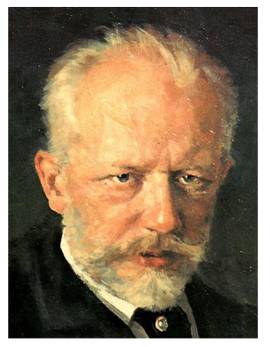
What prompted this blog was not so much a desire to air my secret lapses or to prepare myself and those around me for future, more eye-rolling achievements, but rather, it began with an evening of Tchaikovsky.

More specifically, we went to the Madison Symphony Orchestra concert at the Overture Center in Madison last Friday to hear Beethoven, Ravell, and Tchaikovsky. I was struck by one of the program notes for the magnificent and beautiful Overture to Romeo and Juliet. Allow me to quote from the program. “In 1868, (Tchaikovsky) dedicated an overture titled Fate to his friend Balakirev. While Fate was a complete flop – Tchaikovsky later destroyed the score – it was the beginning of a close friendship, and Balakirev encouraged him to take Romeo and Juliet as a subject…. The first performance in 1870 was unsuccessful, and Tchaikovsky revised the work, incorporating several of Balakiren’s suggestions. He revised it once more a decade later – the version that is familiar today – in particular working the dramatic ending. (Program notes by J. Michael Allsen)

Pyotr-Tchaikovsky-BORDER1


Ah, Peter Ilyich Tchaikovsky, a genius and double failure. Only the third try ten years later was a
success. I am reminded of other failures.


Beethoven had several, including his insistence to be onstage for the premier of his magnificent 9th symphony. Here is one eyewitness report.

800px-Beethoven

Jumping Around Like a Madman


By 1824, Beethoven was almost entirely deaf, but still wanted to be part of the performance and was on stage while the piece was performed to indicate the tempos. Yet, Beethoven could not resist “helping” the musicians on stage by showing them the style and dynamics that he wanted, even though he was nearly deaf.


The great composer’s actions were animated to say the least. One musician wrote, “He stood in front of the conductor’s stand and threw himself back and forth like a madman. At one moment he stretched to his full height, at the next he crouched down to the floor. He flailed about with his hands and feet as though he wanted to play all the instruments and sing all the chorus parts.” It was a good thing that the conductor had already instructed the musicians not to pay attention to the composer!

In another account…

The premiere of Ludwig van Beethoven’s Symphony No. 9 was nearly a complete disaster.

Beethoven’s first on-stage appearance in 12 years in Vienna on May 7, 1824 didn’t go as planned for the premier of the Ninth. It was the largest orchestra that he had ever assembled. It’s known that some of Vienna’s most elite performers were in attendance. Beethoven even had two famous singers sing the soprano and alto parts. Though the composition itself is beautiful, the performance itself was somewhat disappointing.

Many spoke out that they thought it was under-rehearsed and “scrappy” in its execution. It’s said that while the audience applauded at the end, Beethoven was actually off by several measures and was still conducting. A member of his orchestra, Caroline Unger, had to walk over and turn the musical mastermind around to accept the audience’s cheers and applause. But violinist Joseph Böhm stepped forward afterward to praise Beethoven and explain that he was not to blame for the choppy experience.

“Beethoven directed the piece himself; that is, he stood before the lectern and gesticulated furiously. At times he rose, at other times he shrank to the ground, he moved as if he wanted to play all the instruments himself and sing for the whole chorus. All the musicians minded his rhythm alone while playing.”

This failure didn’t hit Beethoven too hard. The audience gave him five standing ovations.

Even in failure we may succeed.

So far, this catalogue of failures merely documents what most of us already know. As the actor Jim Carrey once remarked, “Those who succeed are the ones who just keep going.”

There is another aspect of failure, however, that I believe is more important than seeing failure as merely a step, a pause on the way to success. Failure is important, and I’m convinced it is actually a blessing because what it does to us as humans. Success ruins us. The quicker it comes, the more it ruins us. The easier the success, the more damning the ruin. The greater the immediate success, the more complete the ruin.

How can this be?

Failure enlarges us. Failure in love makes us kinder, deeper, and more able to love greatly. Why? Because now we know its importance, its worth, its cost. We may temporarily become discouraged, angry, perhaps even despondent along with every feeling in between. Even those painful things make us more human. We become truly great by rising out of ashes. Suffering enlarges our capacity. What we often find is that the success we so desperately sought is not really the success we need. The game we are in is bigger than the game we think we are playing.

A child who falls in learning to ride a bike may have temporarily failed, but what that child is actually learning is how to overcome adversity. It’s greater than learning to ride a bike, which that child will learn to do eventually anyway. Which is the greater success – learning to ride a bike or learning to overcome adversity and skinned knees?

History is a catalogue of wonderful failures: Gandhi, Martin Luther King, Michael Jordan, J.K. Rowling, Thomas Edison, Abraham Lincoln, Ben Franklin, Galileo, Vera Wang, Vincent Van Gogh, Emily Dickinson.

emily-dickinson


Jesus!

To those who fail utterly or die in the struggle, even death cannot prevent their greatness, their legacy, their accomplishment, their bequest to the rest of us.

Take heart. When you fail, it is usually temporary; it is a blessed teacher; it increases your capacity and your potential. When you fail, your perspective changes. When you fail, you now have rubble with which to build a fortress instead of a tower. The stone rejected becomes the cornerstone.

I don’t deny the pain. When you fail, I recommend that you do it “big” and try not to die in the process. Then I think it helps to take a step back, put your chin in your hand, study the twisted wreckage for as long as it takes, and then tell yourself, “Wow, that was magnificent. That was one of my best failures e-vah.”


Just When You Think You’ve Seen Everything….

If you’re going to take note of the strange things people do, say, or wear, you must begin with a point of comparison. For a long time my standard of strangeness came from a bar somewhere in Bavaria in 1975. While there and sober, I noticed a strange-looking man at the bar and had to pretend to look at the collection of mugs behind him to get a closer look at the man. He was animatedly talking to friends who seemed to think he was normal, even though the bad toupee he wore was not really a toupee but a tanned hide rabbit skin he had cut and somehow molded to fit his head, complete with sideburns. This was in July. It was not a hat. He had combed a “part” into the top left side.


Ten years later, I acquired a new point of comparison after I had moved to the Chicago suburbs. I had heard that good fishing from the shore of Lake Michigan could be had from the Tower Road Pier because it was near a power plant that discharged warm water into the lake and attracted big fish and lots of perch early in the season. On my first trip I felt a little out of place with my medium-weight rod when a saw a man at the railing looking out at the expanse of beautiful blue-green water, and his “gear” consisted of a five gallon bucket, a hockey puck, a fire extinguisher, and a PVC pipe about three inches in diameter and four feet long. I rigged up and began casting while keeping a careful eye on the more experienced Lake Michigan fisherman. First he tied the end of a coil of line in his bucket to a screw eye embedded in the hockey puck. Then he baited a good ten yards of the line with worms and crickets. Next he stuffed the hockey puck down the tube and used some type of coupling device to attach the tube to the fire extinguisher. Finally with the same care he would use to aim a mortar, he braced the tube against the side of his foot, hit the release valve on the fire extinguisher, and watched proudly as the high pressure in his fire extinguisher blasted the hockey puck and its trailing, baited line several hundred yards out into the lake. No one could have cast that far with a rod. His strange method was a thing of wonder. In an hour, he retrieved his line hand over hand, coiling it carefully in his bucket, and eventually taking in at least a dozen nice-sized perch. I caught nothing.


I expected to see more strangeness when I moved to Madison where just under one-fifth of the population of 250,000 is college students whose first breaking away from parents means “anything goes,” and I have not been disappointed. I have seen a student riding to class on a unicycle, beer hats (not the insignia, the actual beer), kids walking through snow in shorts and flip-flops, and one young woman walking to class in the equivalent of a tasseled lamp shade – a very short lamp shade. I have seen dogs taken for a walk on a leash with a blinking safety bike light attached to the dog. In the dark, you couldn’t see the person, but the dog was safe. Last week I saw a young woman struggling to climb Highland Avenue on her bike with toddler’s trailer attached to the back. As a big fan of babies, I peeked into her trailer to see – a very content spaniel being given a ride. It was a different woman from the one I saw last winter trudging through a foot of snow with one of those baby-carrying snugglies on her chest and long-eared dachshund peeking out of the warm wrap. I have seen bikes with neon rims, bikes with four-inch wide snow tires, and cars entirely covered with bumper stickers, most in the same category as “I used to think I was indecisive, but now I’m not so sure.” O-kay.


Two other things have made appearances because Madison is a college town. Move-in days for probably 10,000 or so new students are usually a Sunday and Monday at the end of August, with move-out day for those changing residences a few days before. During that time, the city runs extra garbage pickup routes because the curbs are piled high with old mattresses, mousy couches, computer desks in various stages of disassembly, desktop computers, printers, tangles of router wiring, deflated footballs, basketballs and soccer balls, loft beds, (did I say mattresses?) and UW cafeteria trays stolen in the winter to serve as sleds down the hill outside Kronshage Hall. If you can imagine an army in full-panic retreat, jettisoning everything they cannot eat, you have a good image of what the Madison curbs look like. The locals call it “Happy Hippy Christmas,” and except for the mattresses and infectious couches, an incoming freshman need not buy anything at IKEA to get ready for school if he can drive around with a pickup truck.


Driving around, though, is something of a challenge. More than once, I have seen wide-eyed parents and a freshman in a car from Pennsylvania or Minnesota driving the wrong way on one-way University Avenue, Gorham, Johnson, Gilman, Carroll, Main, Pinckney, or Mifflin. I have been that parent. Twice. The fathers look bewildered, the mothers agog and the freshmen in the back seat – terrified. Couple that yearly Running-of-the-Freshman-Parent-Drivers with the fact that Madison, especially near and on campus, is a bicycle and Vespa scooter town, and the result is something like a county fair figure-8 race. Imagine such a race with several overloaded U-Halls, four mini-vans, two motorcycles, a tractor, six bicycles, four speeding pizza delivery cars, seven joggers, and a snowmobile. It’s not quite a demolition derby, but there are a lot of close calls to keep things interesting. Fortunately, the locals have learned to watch out for the lost, confused, wide-eyed parents of freshmen. I have seen police cars screech to a halt in front of them, lights flashing, in an attempt to protect the hapless parents. Usually the police don’t use their sirens then; I assume they have learned that a loud siren only makes things worse. Apparently, there are quantum stages of panic.


I saw one parent unfortunately heading east on University Avenue, realize his mistake too late and pull over the curb and across the bike path to park diagonally on the sidewalk and wait for the police. The father’s head was on the steering wheel; the mother looked like that painting by Edouard Munch called “The Scream,” and the freshman girl in the back seat was crying but looked strangely relieved. Unfortunately, my phone was not in picture mode at the time.


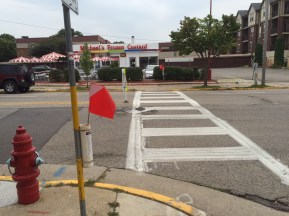
Another danger spot is near State Street, because cars are allowed to cross it at a dozen places with some six-way intersections, but no cars are allowed to drive down State Street in either direction. Students there usually flag the parents down before someone gets hurt. At many intersections in town there are canisters of orange flags that pedestrians can use to flag down motorists. Pedestrians are supposed to have right of way on all crosswalks, but …. Sometimes I think they should do away with the flags and just set up barrels full of water balloons. Rotten tomatoes might also work. If my car got hit by a water balloon or a tomato, I would stop.


IMG_1739


Strange life is not always related to driving or schools. On July 4, I rode my bike along a nice path to Blackhawk Golf Course, where there was a wonderful fireworks display after a lively Sousa concert by the Wisconsin Chamber Orchestra and a chorus of the National Anthem. After an hour-long booming display and a finale that lit the hillside, several thousand spectators packed up camp chairs, blankets and coolers to make our way across the 8th fairway, a ditch, and a railroad crossing inn the dark to parking lots and the bike path. Most of us used flashlights to get back. Directly in the path of almost everyone near the railroad crossing was a couple on a blanket, making out as passionately as anything I’ve seen … anywhere. They did not stop when the crowd split into two streams to go around them. Giggling children did not stop them. A dozen flashlights aimed at them at one time did not distract them. Two dozen “Oh, my Gods” did not stop them. They were not even distracted by a snickering teens who paused to applaud them. Ah, youth.


On my way back home along the bike path in darkness only occasionally lit by solar-powered path lights, I saw a wavering light coming at me, but it was too high for a bike light, and I couldn’t believe some giant was shakily just learning to ride at night. When I got closer, I saw an ordinary teen steering her wobbly bike with one hand, and holding up her smart phone to light a dim way with her other hand, not on flashlight mode but on end-of-concert tribute mode. It was a bad idea for at least a half dozen reasons. I hope she made it home.


Last week, while traveling through the east side of Madison, known unofficially as Hippie Central, I noticed for the first time that some knitting fiend had somehow attached knit squares into eight-feet-high tubes around trees on the parkway. I don’t know if the trees were embarrassed by their bad sweaters, but I was embarrassed for them. I heard from our daughter-in-law that the same decorations exist somewhere in Evanston, Illinois, just off the campus of Northwestern University. Lately I’ve heard this phenomenon exists all around the country. See below. Those poor trees.


images


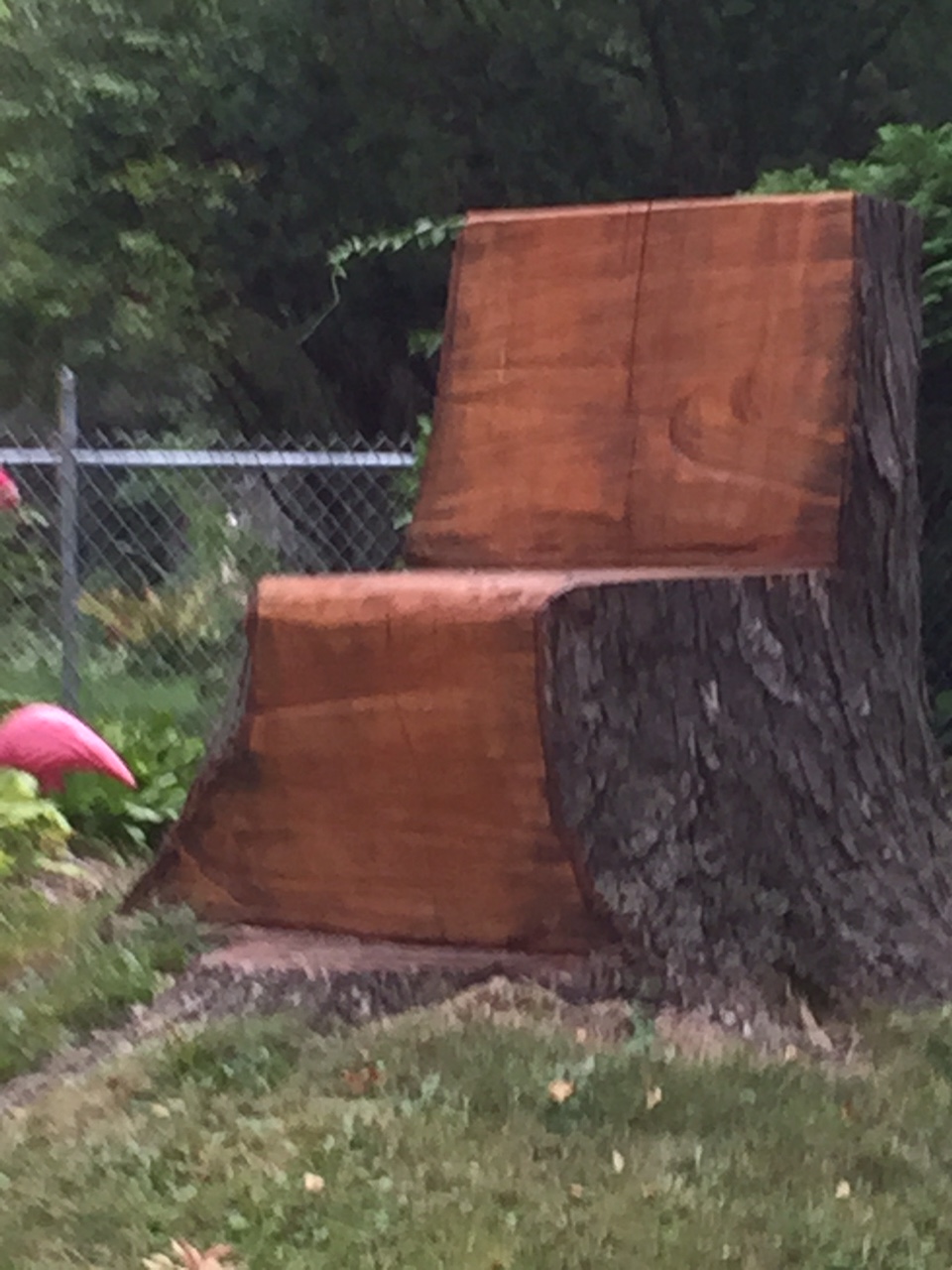
Speaking of trees… Ann and I took a walk to a nearby coffee shop this morning. Unfortunately, Madison is fighting the emerald ash borer these days with an added surcharge on our utility bill each month of about two dollars to fund chemical treatment for threatened trees. We’ve seen stapled messages on some trees around town announcing an applied treatment. For some trees, it’s too late. What can be done with the remains of a stately old tree? Here’s one solution we saw. The pink flamingo is added for a touch of … kitsch?

IMG_1737


Dempster Avenue in Evanston is an amalgam of many interesting cultures. Its shops range from temples to hookah lounges, from pita house restaurants to hot dog emporiums. During my last drive, I saw a very smartly-dressed Hasidic Jew on the sidewalk in a neatly pressed black suit, white shirt, tie, long curls, and wide-brimmed hat. His black shoes shone like ebony as he – wait for it – pushed himself along the sidewalk on a scooter. I don’t know what the typical Hasidic woman would think, but I thought he looked pretty cool.

I hope that this post will not end with me. If you choose to respond, please attach your favorite, “If you think you’ve seen everything…” I can’t wait to read about the rich tapestry of craziness we are collectively creating, not that I’ve ever done anything strange, you understand, except maybe for that one night outside Waterloo when several of us young campers thought roasting a chicken sounded good and, um, never mind.


A Life After Retirement

This blog is about retirement (or not) and why it’s important to say, “Okay.”

I retired four or five years ago after 36 years of teaching English and serving as a department chair. Once you retire, the passage of time changes, so you don’t care to remember whether it was four or five years ago. As one of my good friends and an art teacher, John, told me when he retired two or three years before I did, “Kurt, the main thing to remember in retirement is that the big paper arrives on Sunday.” That has been helpful in keeping time straight.

Two or three years ago I went back to work, sort of. Because of the way the wonderful state of Illinois deals with its teachers, I was short four quarters of Social Security credit, and my 36 years of teaching did not count. Any Social Security benefits did not matter because anything I collected there would be taken from my teacher’s retirement dollar for dollar to avoid “double-dipping” and make sure I didn’t get an undeserved $200 per month for dental insurance. What DID matter is that I did not have enough quarters to qualify for Medicare, and according to the Illinois retirement plan, you MUST qualify for Medicare somehow because they will no longer allow you to be a part of their medical plan once you reach 65. One’s work as a teacher in Illinois does not qualify for Medicare. Have you read Catch 22? That’s the short version. The long version is more about Illinois not wanting anyone to retire, so they just ignored all retirement plans for about 20 years as a way of balancing the budget and then used the money that teachers themselves contributed as collateral to borrow more for their pet projects and their own legislative and executive retirement plans. It doesn’t make sense, because in Illinois, governors don’t usually get a retirement plan payment; after some odd number of years in office, they usually get six to twelve years in some Wisconsin minimum security prison.

I could have been a substitute up here in Wisconsin and contributed to the upkeep or incarceration of some former Illinois governor, but I was really looking for something different. It turned out to be quite different, and quite eye-opening.

I heard about a local software company that was growing by leaps and bounds, and I applied online because I heard they hired teachers to train clients in their software. It turned out they only hired full-time teachers who were also called on to travel and trouble-shoot. They said they had their own part-time temp workers who might be asked to help out anywhere in the company from horticulture (the campus is beautiful) to administration (someone has to look at resumes) or culinary (their chefs and cooks serve at least 4,000 gourmet meals to staff and customers every day). Was I interested in temp work?

I said, “Okay,” just so I wouldn’t have to take papers home to correct, or meet with angry parents to tell them their son will not graduate in two weeks, and no, he cannot just walk across the stage to please Auntie Mame and finish his course requirements sometime in the summer (or never).

A month later this corporation called and said a woman in the kitchen had slipped on ice and broken a bone. Would I be willing to brew coffee in 35-cup hot pots for a month or five weeks? I said, “Okay.”

In two days it became routine to brew 50 hot pots for their meeting rooms and lounges, stop for lunch, joke with the other culinary people, clean up and go home. No papers, no angry parents. In five weeks I retired again, now only three quarters short of Medicare credit. It was good because the amount of rich coffee I was ingesting made me a little j-j-jittery.

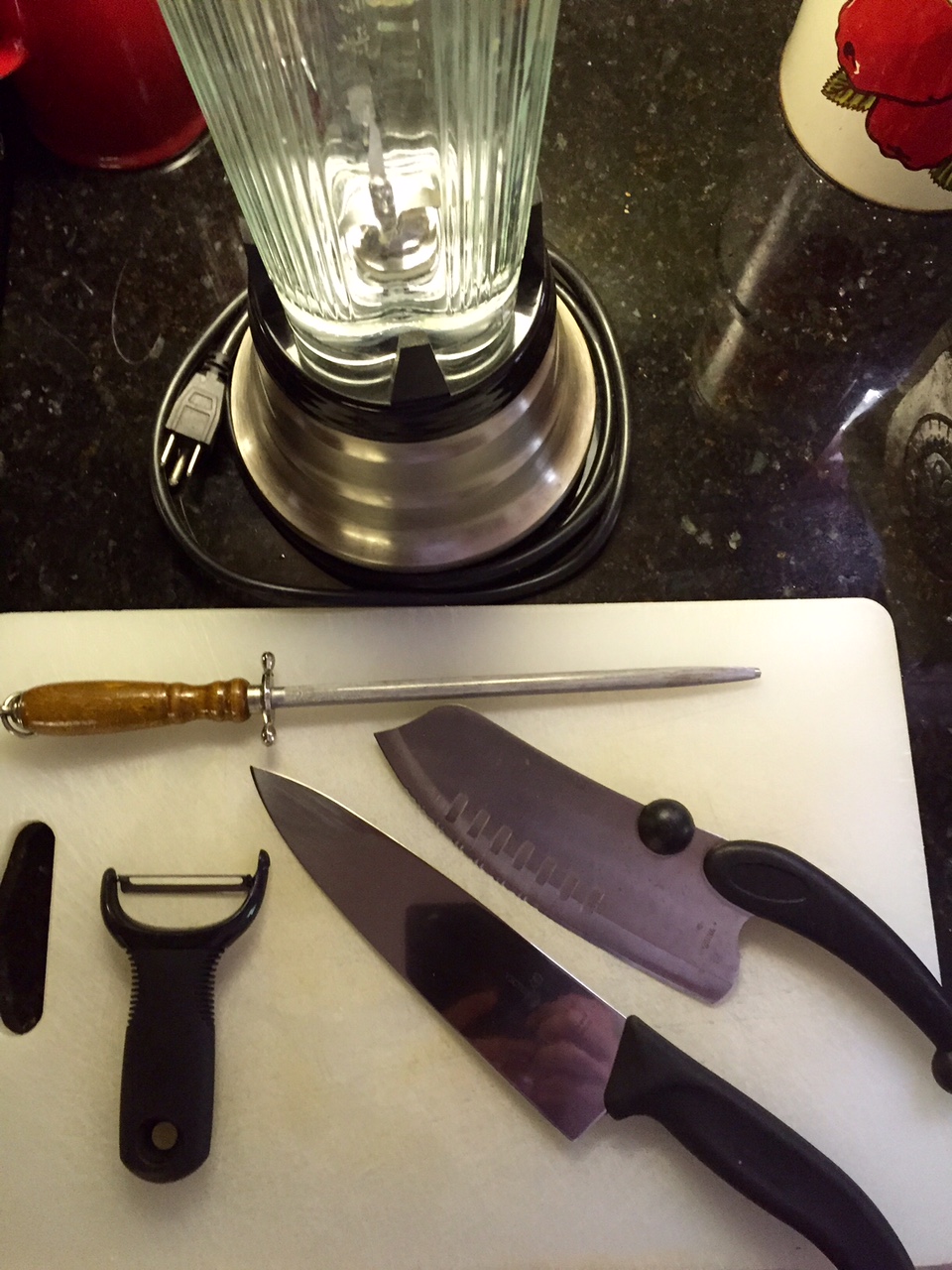
A month later they called again. The husband of the woman who broke her ankle had gone for a physical and needed an immediate triple bypass. Would I help in the kitchen? I said, “Okay.” For the next six weeks, I helped set up a salad buffet and learned from the chefs how to hold a knife, chop and wash five cases of lettuce in the shortest time possible, dice onions without contributing any of my own blood, and mix salad dressings in five-gallon buckets. At one point, a chef noted I was getting better at using a chef’s knife and I said, “Thanks, but if I tried to go as fast as you, I’d lose a finger.” The chef said, “Well, Kurt, then you could be a cook for ten days.”

FullSizeRender


I was learning a lot. Don’t walk behind a chef without saying, “Behind!” I never knew if I was talking about theirs or my own. If you are walking with a chef’s knife, be sure to hold it straight down and call out, “Sharp!” any time you’re near someone. If you’re carrying a pot of soup, be sure to call out “Hot! Hot!” every couple of steps. The efficiency of a kitchen is amazing. Chefs work hard; they know what they’re doing, and when they’re finished with one project or are waiting for soup to simmer, they help someone else.

At one point I was asked to make a seasoning “rub” for 25 cases of chicken breasts. They gave me a Lexan mixing tub about the size of a coffin and a list of ingredients that began with 12 1/2 pounds of paprika, 4 1/2 pounds of ground black pepper, 2 pounds of salt, and so on. Mixing was done with plastic gloves that covered my arms up to my elbows. When I thought I was finished, I asked one of the chefs to check it. He didn’t taste it. He looked at the color and said, “Add another half pound of paprika.” They don’t measure much. Sometimes they taste and sometimes they just look at a batch and say, “It doesn’t look right. Add some more brown sugar.” Recently another temp mixed five gallons of Caesar dressing, and three chefs gathered to taste it. Soon they began to argue about what it lacked. Finally, the head chef tasted it and said, “Ooh, this is really good. It’s not Caesar dressing, but it’s really good. Go with it.” Everyone was happy.

On another occasion, the 35 gallon plastic drum we used to spin washed lettuce jammed, and one of the cooks took the top off to un-jam the spinner, but forgot to turn it off first. At that point, the drum ran free and instantly began to spin at top speed, throwing chopped Romaine around the kitchen, pelting everyone with wet lettuce. A lettuce food fight ensued, with the hapless cook the target of most throws. It wasn’t really a food fight; it was more of helping to clean up by throwing all the lettuce back to one central location marked by the cook who took off the top of the spinner. The head chef was not present at the time.

A year or two ago, (I’m not sure when… whatever, the big paper comes on Sunday), I earned enough credits to qualify for Medicare, but I have continued to work in the kitchen two or three months a year because I was learning how to cut and cook from experts, and because it was fun. More important than any pay was the perk of being able to bring home leftovers that could not be saved or re-used. That often includes fresh fruit salad, Caesar salad, and once, roast pheasant, roasted red potatoes and marinated asparagus. They’ve had leftover deep-fried bluegill, creamed soups, every kind of pasta imaginable, and desserts that won’t keep. It’s always good to earn “points” with your wife. Bringing home leftovers that would otherwise spoil is a lot more fun than bringing home papers to correct.

Although I’ve joked about putting on ten pounds every month I work, I’ve also gotten a lot of good exercise. The Fitbit my son and his wife bought for me says I’ve been walking an average of six miles per day when I work in the kitchen.

What is this experience really like? Watch a segment of Downton Abbey when the cooks are working in the scullery, and you’ll get an idea. Now imagine you’re cooking for several thousand people; the soup vats hold fifty gallons each; the menu lists a choice of three entrees per day and 400 of each entree is prepared, and a typical fruit salad prep will include six pineapples (sliced a certain way), three watermelons, a case of grapes (about a dozen packages to be hand-picked), a case of strawberries, and a couple of honeydew melons chopped in one-inch cubes. Now imagine that the kitchen I’m in is only one of five that may be prepping at full capacity that day. Most amazing of all, I’ve heard that the food in our dining halls is free to the staff; they pay only our salaries and costs of preparing. A typical grilled salmon dinner with rice and a vegetable would cost $5.00. A marinated flank steak dinner with mashed potatoes and roasted vegetables might be $6.00. At least 40 choices are available at our salad bar, and full square plate piled high is $3.50. This is not your typical corporate cafeteria.

The chefs and cooks have been lured away from Madison’s top restaurants by offers of regular daily hours, insurance, a retirement plan, and no night work, holiday work, or weekends. I’m learning from the best. Ah, retirement! I just retired again Friday. Time to go trout fishing.

One final thing I’ve learned…. I have great respect for anyone in the culinary segment of the workforce. A tip from me in any restaurant is now 20% minimum, usually 25%, and worth every penny. These are hard-working, highly-skilled people, and all the ones I know still have ten fingers. That’s is quite a feat. They deserve an extra dollar or two. I’d rather support them than an Illinois governor in some minimum security – you get the idea.

7 Strategies to Beat Writer’s Block

Probably the most famous bout of writer’s block infected Mark Twain, who wrote the first half of his sequel to Tom Sawyer, got stuck, and then finished The Adventures of Huckleberry Finn in a rush after about a four-year interval. Four years is a long time to have writer’s block, although in Twain’s case, it meant that he simply moved on to other things.

220px-Huckleberry_Finn_book


I have also heard that a serious strain of writer’s block attacked Sting, who wrote lots of songs with The Police, had a full solo career and then everything stopped – for years – until he learned to write songs that told stories or explored the past and characters he created and were not just about a current topic of interest. He learned to do what Mark Knopfler has been doing in music for years – don’t just report in music something that occurs to you or happens to you – create it and people the songs with your creations.

That’s the first of my practices for defeating writer’s block – Wait it out. Wait for people and things to appear. Waiting is difficult for a writer, even for a day or two. A day or two may be an average gestation period, nine months is a scary period, and four years is too long. Twain once commented that writing required an “incubation” period and trusted his subconscious to be working even when he was not. My subconscious often goes fantasy fishing instead of working on a story, but it comes around eventually. I have less control than early Greeks had over a muse, and they apparently had none.

What is one to do while waiting?

My second strategy to cure writer’s block is to write about other things. Blog, do journal entries, begin a second Great American Novel, write love letters to your enemies to confuse them, and if you’re really desperate, do crossword puzzles so you are thinking about words you almost have in mind. That searching for words is not much different than the actual work of writing. Besides, anyone who is only working on one piece at a time is probably not a writer – he or she is a journalist with an editor breathing down his or her itchy neck. Those poor unfortunates may sometimes end up doing what no self-respecting writer would ever admit – write crap on a subject they were assigned; they know it will get published but few will read it and no one will remember. They do it because they have to – until they switch jobs.

Strategy Number 3: Re-read and keep re-reading what you have written, from the beginning if necessary, so your subconscious gets so bored with it that it will be forced to come up with something worthwhile just to get you to stop breathing down its neck. If you really want to aggravate your subconscious into becoming your working partner again, re-read what you’ve been writing right before you go to bed. That way, your subconscious is primed to dream about what you’re writing instead of that strange trip to a lush isle where something or someone is rustling the bushes behind you. To a balky subconscious, re-reading what you’ve been writing is like planning for a dreamland flight through the Grand Canyon without a plane because you can fly, and then just before the take-off – wham, you’re grounded. You can cure writer’s block by nagging it unmercifully. Since your subconscious is probably a teen-ager (I believe most are), the nagging is much like getting it to clean its room. Wonderful, forgotten treasures often appear, and if not, you’ll at least get missing socks to pair with their orphan brothers.

Strategy Number 4: Take Courage. Sometimes writer’s block is simply due to fear, the kind of thing Harper Lee apparently faced after penning the magnificent To Kill a Mockingbird. She may have been writing after that, and perhaps her second book, The Watchman, may actually appear twenty years after Mockingbird, but I find it quite understandable (though not from experience) that such first success would be hard to follow. There are certainly times when a blank screen – that terrible white ghost like a vaporous Voldemort in Harry Potter – dares you to make a fool of yourself and challenge his unwritten threat. That white screen is sometimes not a playground; it is an abyss. It need not be white and blank; it may be a black hole into which all words and thoughts spiral, never to re-appear.

If that happens, first write an incantation. A prayer would be more effective, but I’m going to stick with the original metaphor. Simply write: Lexicus apparatio spirituus maximus or any Latin-sounding gibberish to the same effect. Then you say, “Take that! Voldemort, you hollow-socketed, whispering bog-wallower.” Then you can launch a courageous attack with words – power words are best – as you write an action scene using thrust, juggernaut, thunder, hurtling, stormed, defiant, stanchion, surmount, and end the paragraph with something magnificent, such as, “and so truth rises.” You will probably keep none of it, but you will be writing, and the blank screen will become your canvas, your sandbox, your whiteboard or your sky. Write courageously; write with anger, if necessary.

Courage always can defeat fear, but you have to make it so. Fear only wins when you let it. The more you practice courage, the more of it you will have until one day, you face even the palest, most vaporous white screen and say out loud, “Bring it on, you pale, sucking nothingness.”   Then you write.

When that session is over, you give yourself a medal. Mine is usually chocolate. Edible medals are the best.

Strategy Number 5: Write without Expectations. Do not judge. Just write. Do not edit. Just write. Do not expect anything good. Just write.

I have found that an interesting thing happens when you write without expectations. I will sometimes write five pages of useless drivel, and then suddenly on page 6 an amazing paragraph or two will appear, as if out of nowhere, and I wonder, “Where did that come from?” and immediately I don’t care where it came from; I just go with it, and it goes to some place wonderful. You don’t have to keep the first five pages.

If you practice shooting 200 free throws every session, no single group of 10 will be remembered, but eventually you will make 7 out of 10 and then 8 out of 10. An interesting thing happens when you practice writing like you shoot free throws. It looks like this. Miss. Miss. Miss. Miss. MAKE. Miss. Miss. Miss. MAKE. Miss. Miss. MAKE. Miss. MAKE. MAKE. MAKE. In shooting free throws, even the “makes” fade away, but in writing, you keep the “makes.”

Your “make” may not even be part of a story. Maybe it’s backstory. Maybe it’s a sketch that becomes a flashback. Maybe it will become Huckleberry Finn after you finish Tom Sawyer. You may not know what it will become for four years. Write it anyway.

Strategy Number 6: You can get unblocked by making up questions and then answering them. If a character is lost in a swamp, ask, “If something surprising appeared that would lead this character deeper into the swamp and then out of it, what would that be?” You can always ask yourself, “Why did my character do that?” You may not know in a story what comes next, but you can ask, “What can appear out of the past that makes sense?” “What matters here?” “What if …?”

I remember a time when I was writing Hibernal when my main character had barely escaped political threats in Chicago by running away to a quite unlikely place – the Northwoods of the Upper Peninsula of Michigan, and holed up there for the winter. After you write about the Northwoods being snowy and cold, lonely and cold, what is left? I asked myself, “What matters now?” What matters now are inner demons, stories from the past that he tells himself, unspoken fears, and imagined threats that will first appear as memories and then later – aha, in the first thaw of spring – a bear, Faulkner’s bear that is more than a bear – it is the sum of his fears. From that point, the story wrote itself.

Questions are teachers, Socrates knew, and the more unanswerable the question, the better the teacher. Real life and good stories are packed with partial answers to good questions. Write them.

Strategy Number 7: What Good Writers Do. Many years ago (20 or so?) I took a class on writing at the University of Illinois and spent a lot of time doing research on creativity. One of the things I remember (a miracle in itself), was some research by Linda Flowers, a prof, I believe, at one of the Wesleyan Universities. (not the Linda Flowers who styled hair for The Hunger Games – heavens!) She worked diligently at examining protocols – the typical behaviors and thoughts of writers as they wrote. Often she would simply stop writers mid-sentence and ask what they were thinking/doing at that moment. One of the interesting things she learned is that poor writers seemed to fall into a rut in which they were stymied/stuck by minor things such as spelling or questions about punctuation, which would sometimes cause the derailment of a train of thought, or they would simply go back to re-read their last sentence and try to add on, often merely repeating their last idea in different words. They became very frustrated when she put them on machines so that only their last words were visible, and as they typed, their sentences would disappear.

Fluent writers, on the other hand, told her when they paused, they were going back to develop focus on important things: their main point or thesis, objections readers might have, who IS their audience, and the ramifications of what they were thinking. When she put fluent writers as seen by the quality of their writing on machines where only their last words were visible, the disappearance of their last sentences made no difference.

In other words, when good writers reach a pause-point, they GO BIG.

Similarly, when I write fiction, my BIG THING for any chapter is already in an outline. I may take some detours when something unexpected occurs to me, but more often than not, when I am writing, I feel like I’m in a car and I already know to turn left at the big oak in the middle of nowhere, and then begin to look for the bridge over a muddy creek. I know it’s just up ahead. In a way, writing is driving.

images


This blog entry is no exception. As I write, I see that I have come to the end of two pink Post-it notes with seven bullet points on them.

I guess I’m finished.