It Is All Good

Today’s inspiration started with music. One of the first inspirations for me, something fifty years ago, was the Beatles’ I Want to Hold Your Hand. I remember taping and playing that song over and over again, not so much to listen to it, but to feel it. Eventually, I overplayed it, and the feeling passed. It was followed by the Rolling Stones’ Honky Tonk Woman, The Animals’ House of the Rising Sun, and dozens of others, Springsteen’s Born to Be Wild, Knopfler’s Sultans of Swing, and much later on, Keith Urban’s You’ll Think of Me. More recently, I’ve greatly overplayed the Decembrists’ Down by the River, Adele’s Someone Like You, especially the YouTube version by Charlie Puth and Emily Luther, and this month, Mumford and Sons’ I Will Wait. I’ll admit that some of this repetition is due to the corporate radio’s tendency to promote anything that looks like a winner, but I think something else is going on. I’m feeding an innermost part of my brain, the same way a drug addict does, the same way a runner pushes past the wall to get that stream of endorphins, and the same way lovers love. The songs help me to feel something I like, even if sometimes that feeling is vicarious pain. Each song stimulated a different feeling, but they were all good in their way.

I believe three physical laws are operative here. The first is our need to feel something, sometimes anything. The second is the vicarious law of literature, video, and music. We are attracted to the sharing of other’s stories, their triumphs, and even their pain, as long as we don’t have to feel the real pain ourselves. I want to watch Abraham Lincoln and feel some of his ups and downs; I do not want to be him. The third law is that of diminishing returns. It is a wonderful blessing both to our families and ourselves that the repetitive playing of Mumford and Sons eventually bores us and we must wait for another such masterpiece or not play the song for a year.

Ann and I are currently taking a wonderful course based on Rosenberg’s book Nonviolent Communication, which I’ve recommended before. Mary Kay Reinemann, our inspiring teacher, tells us regularly to watch for feelings. They are messengers. Anger is a messenger shouting a need. Every feeling is a please (help me) or a thank you. Hatred is please help me; I am overcome by fear. It is shouted out through a Marshall double stack amplifier with the volume on max. It is written in giant, red, bloody letters. Kindness is a thank you. Communication is more complicated than that, but you get the idea. You can also see why we’re taking this course for the second time, just so we can practice with others. The point is that feeling, even unpleasant feeling, is life, and numbness is death. To feel nothing is to be nothing. It is true that we also think, but even thinking can be dominated by feelings, and I never listened to I Want to Hold Your Hand because it gave me a thoughtful, philosophical position in life.

The second law, the law of vicarious living, is also a gift in disguise. We all must work for a living, and that work takes up so much time and energy that we do not usually have the space to be Humphrey Bogart, Harry Potter, or Lady Mary Crawley finally married to her Matthew. We can choose to live such lives, to feel what they feel, and not actually have to say goodbye to Ilsa, be orphaned by another wizard, or feel the anguish of ruin, scandal, or loss. We may live many lives in one. Their reality, even if we don’t participate as deeply as Walter Mitty in his secret life where he pilots a submarine or saves a life with a pen is real enough. We feel a measure of what they feel. We become them to a degree, and that degree is just enough. That degree can be geometrically multiplied. We may be Lady Mary and Matthew, and Lord Grantham, and any number of maids, footmen, and butlers. We may even be scoundrels if we choose. To feel them is to live them, and it is a blessing.

The third law, that of diminishing returns, is also a blessing. When we choose to love and marry, we feel intensely and wonderfully, but also, we cannot feel that same intensity forever. This is providential because one’s spouse is bound to change, as are we all. A marriage based only on what a partner was like at 22 is a marriage in trouble. I believe the best marriage is one that assumes a trajectory. My wife is not the woman she was at 24; she is better, wiser, more alive, and I had a pretty good idea that was going to happen. The law of diminishing returns also forces us to grow, to change. Stasis is death. The law of diminishing returns forces the creation of a fifth symphony after we have tired of the other four. It forces the creation of What About Bill after we have tired of Groundhog Day, and a third season of Downton Abbey after the late night kiss in the snow that ended the last season.

The law that rules this world, including our own brains, is providential, blessed, and necessary because it nudges us to live. It is all good.
On Little Things and God

The devil is not in the details; God is. One of the advantages of being over 60 is that age affords perspective, and all the teenage angst over am-I-good-enough, will-she-like-me, oh-no-the-test-is-TODAY is long over. This perspective tells me two things of which I am absolutely convinced. One is that little things are important. The other is that the most important thing we have is time. I just finished reading The Little Book of Common Sense Investing by John Bogle, whose long-term study shows that having a whole lot of money to invest means a lot less than investing over a long time and doing it sensibly and without the excess of greed. A smaller return by owning shares of ALL stocks to minimize risk, avoiding investment costs, and holding everything for a long time beats all other strategies. Once you don’t care about making a million by day trading, searching for the next killer pick for this month, or giving all your money to someone who charges you to invest your money, you can make a million or more.

Enough about money… I said God is in the details, and that deserves some explanation. It’s not just that Jesus was born in a manger, the smallest, least important place ever, he never led an army or held an office, and was not even comfortable with the title “Messiah,” because of political connotations, preferring “Ben Adam,” or “Son of Man.” Nor is it just William Blake’s exhortation to “see the world in a grain of sand and a heaven in a wildflower,” or Tennyson’s study of the flower in the crannied wall. By Divine Design, I see that good little things done over a long time amount to great consequences. It’s all in understanding the details.

Read Malcolm Gladwell’s book, Outliers, which shows that ordinary people (and the Beatles were ordinary people) who practice for 10,000 hours (their time spent in German cabarets) will become remarkable musicians. Even Mozart was an ordinary composer until he put in his 10,000 hours. I’ve written about this before, but good things sometimes bear repeating.

Log on to TED Talks and watch the short video by Amy Cuddy on how little things like posture, power poses and self-talk can change not only the testosterone and cortisol ratio in your body that makes you strong or stressed, it also results in a better, more successful YOU. It doesn’t really hit home until Amy tells her own remarkable story two-thirds of the way through the video. If you watch nothing else all week, watch this. (Amy Cuddy: Your body language shapes who you are) Our bodies were simply designed this way. Fake strength until you make it; make it until you become it.

Exercise? I’m finding that I don’t need to be a marathoner, and my knees probably wouldn’t take that stress anyway. It is still remarkable after a month of slacking off because of eye surgery, that if I just go back to thirty minutes of stretching, breathing and weights in the morning, followed by thirty minutes on a treadmill watching TED talks, I not only feel better and have great energy, I am alert rather than tired, kinder (or at least less crabby), and more able to write. I will never look like a football player, have six-pack abs, or be able to dunk a basketball, but stretching, breathing, and walking for thirty years has made me feel well and kept me from getting soft and fat. That is enough. It’s actually a big thing when I look around me at those who struggle to get through the day or go up a flight of stairs. I’m not bragging since I have so many other weaknesses; I’m observing. Little things done over an extended period of time make a big difference.

About two weeks ago I saw Warren Buffet on The Daily Show with Jon Stewart, and I was amazed at his attitude and answers to Stewart’s most challenging economic questions. In short, the wise, smiling man, perhaps the best investor of all time, delivered a truly optimistic message: Of course there are bubbles and even recessions, but that’s just an opportunity. That’s the time to BUY. The point is that the general trend is upward. It is all done little by little over many years.

That’s how we do everything. It’s the message of Anne Lamott’s great book on writing, Bird by Bird, which I’ve recommended before. What is new for me is that I see this “Little Things Are Great – in the long run” is by design. If you write, it takes at least a couple of years to turn out a good novel. If you pray for something good for someone else, it may take a couple of years for the miracle to appear (unless you are Jesus and I am not). If you want to be a great musician/composer/free throw shooter/landscape painter/teacher/parent…ANYTHING – it will probably take ten thousand hours. If you repeat affirmations, it will still take a couple of years for that little change to take effect. My only suggestion would be to make sure you choose something you love to do, because 10,000 hours doing something you hate is no fun and not good for your psyche. The testosterone/cortisol ratio will not be in your favor.

How amazing this world design is. Because of this design, great things are available to all of us by doing little things for a long time. Everyone is familiar with the adage, “The devil is in the details,” meaning it may be the little, unnoticed thing that causes a problem, but most people probably do not know that the original saying was most likely by Gustave Flaubert, “Le bon Dieu est dans le détail.” It’s not the devil in the detail; it’s the good God.

Junk and Memorial Day

Junk and Memorial Day

Having moved to Madison a year ago, we were forced to look at more than the things we carried; we were confronted with the things we had accumulated over thirty years in the same previous place. For months we sifted, boxed, threw away, or gave away books we would never reference, old rollerblades, gloves, hats, jean jackets (yes, you CAN have too many jean jackets), and boom boxes that won’t connect with an iPod. Even now in a new house, we continue to find surprises in boxes stacked in our basement, (oh, THAT’s where the corn popper went).

It has been interesting to see the shift that things make from “stuff” to “junk.” I know it’s a global problem, not only because of the zillion acre toilet bowl out in the Pacific that swirls and swirls but can never flush the bottles, bags, vials, and plastic canisters too large for the birds to eat, but also because stuff is everywhere and we don’t even realize it is junk. Is junk food really food? Is spam on your computer really information? We live amid pink slime, junk mail, paper piles, and clothes we never wear. I am not innocent in this problem. My “green” footprint is a pair of EEE clown shoes. I can work on that. I know where the Salvation Army dropoff box is. I’ve promised to go through one box a day in our basement to store, use, or give away most of what we’ve accumulated.

The problem is bigger than plastic, junk food, or unsolicited credit cards. We have too much junk everywhere in our lives. Let’s start with email. I am amazed at how many emails I receive in a spirit of shock intended to create anger in me about some politician, government program, or scandal that turns out to be merely junk. If it fits one’s view or political philosophy, it gets passed on to dozens of others, unchecked. Sometimes I feel like the only person in the Midwest who uses Snopes, Factcheck, or Politifact. It’s an even greater sign of the disease that I’ve started getting emails attacking Snopes and Politifact in ways that are untrue. Even when I find something partly true, the missive is riddled with cherry-picking one or two facts, the fallacy of argumentum ad hominem, and unsupported generalizations. I thought we learned to avoid most of those in sophomore speech class. This stuff is worse than clutter; it’s junk.

So what do we do? There are plenty of books about sorting through the clutter in our lives based on how much we actually use things, so I’m not going to write about that. Their greatest weakess is that they have no idea how important old fishing equipment is. I’m more concerned with the junk in our minds. We shouldn’t let it in. That starts with a commitment to truth, not just an automatic, “Yeah, that guy ought to be in jail.” We know that some sources are better than others, but even so, I trust only what I read in multiple sources. If something is intended to make me angry, I immediately discount it, not because it is automatically false, but because the intent of the writer is not to inform me, but to make me angry, and if there’s one thing we don’t need these days, it’s more negative emotion instead of cooler heads. Besides, anger is even more self-destructive than it is destructive of others. So the first screen for me is information reported from multiple trusted sources in a way that doesn’t intend an angry response. Even the report of the worst thing possible, a murder for example, should not prompt a response in me that says, “Let’s get a posse together and go kill that guy.” It might seem just, but it’s terribly destructive for what it does to me.

The second screen for me is a reflection of the colors of reality. We do not live in a black and white world. No one is all bad, nor all good. No action is all bad, or all good. My response to life ought to be, “Yes, and…” or “Yes, but…” This is especially true politically. I find it impossible to argue that any one party has served our country well over a single election cycle, much less an entire generation. To me, even the labels, Democrat, Republican, conservative, liberal, independent, have become meaningless. References to Hitler are automatically dismissed as hyperbole.

My third screen is the taste test. What were the fruits of any action, policy, or law? Did it mostly help people? Did it help many people, not just a select few? Was it worth the cost? This test alone makes most wars a waste of precious resources, and if you don’t believe that, look at the latest data on maimed soldiers, and the fact that nearly half of all who survived their tour(s) have applied for disability.

On this Memorial Day, we ought to do more than attend a parade and remember someone we lost. Those are not enough. We ought to pledge to be better citizens, to worry less about how any one thing concerns me and worry more about what is true from reliable, multiple sources reported sensibly, what are the complexities and colors in every person and event, and what are the fruits of our actions? We owe the dead that much, but we also owe it to the living, our fellow citizens, our children and now for me, a grandchild. Let’s clear out the divisive, angry, self-serving, inaccurate, wasteful junk in our minds.

Gwen Also Says

Gwen says, “If something is true, so is its complement.”
If you want an explanation for why we have male and female, black and white, summer and winter, night and day, left brain and right brain, this is it. These are not opposites. I suspect there really are no opposites, only complements in which we can’t see how they fit together.

Modes of Thinking

Yesterday I went to the Flyfishing Federation’s “Opener” in Madison and listened to a talk by one one of the best writers and flyfishers in America, Dave Hughes. Surprisingly, he began his presentation by recommending one of my favorite books, Blink, by Malcolm Gladwell. His point was that the more you fish or know about anything, the more you can trust your instantaneous intuition or judgment about it — where the trout are, whether you can believe what someone just said, or who this person standing before you really is. That led me to thinking about thinking. Here’s what I think…..

I have experienced the truth that an immediate thought about someone or something, an intuition or immediate feeling, almost without thinking, is most often true. You may not be able to judge a book by its cover, but if along with the cover you sense the condition of the book, hear an opening line, notice the poor spelling, the lack of punctuation, and the sense that you are being drained while merely holding this book, trust your judgment.

I’ve also noticed that in most discussions, especially those that may be heated or confrontational, men are at a disadvantage. Women process feelings more quickly, and often men (or at least I as a man) don’t think of what I really meant to say until the next day. It doesn’t really matter because nearly all arguments are useless. Even if you win, the couple loses. Jackson Browne said it in “Tender is the Night,” when he sang, “I win; you win; we lose.” I believe I have been saved from many difficult apologies by NOT being able to say something hurtful or defensive until I think of it the next day when there is no opportunity to say it. In any disagreement that is not about safety or probable disaster, given a choice between being right and being kind, always choose being kind. All relationships are reciprocal, and no one really wins unless both win.

I also know that much of our thinking is comparative. Making comparisons is a useful tool that allows us to get through an ordinary day. It’s important to be able to compare green lights, yellow lights and red lights. That is especially true when she says “Well….okay.” Is that really a green light or a yellow? However, most comparisions are not that helpful. As I’ve written before, who is the better artist, Van Gogh or Matisse, Beethoven or Mozart? Why am I not as lucky/rich/handsome/popular as….. Such comparisions really are odious. I need to be careful of such dangerous thinking.

The thinking I find most intriguing is “deep well” thinking. This most often is creative thinking. Like a deep well, getting anything out of our superconscious takes time, and the deeper the well, the longer it takes to get that bucket of cold, clear water up to the surface. I read that Mark Twain worked for quite a while on his masterpiece Huckleberry Finn, the book some have called the Great American Novel. I agree that it is not a young adult book, more the coming-of-age book for an entire culture. Halfway through his manuscript, Twain had Huck and the slave Jim a long ways down river, with no way to get them back to Hannibal or end his story. He put his manuscript in the back of his roll top desk. Two years later, Livvy insisted he clean out his firetrap of an office, including his half-smoked cigars. He found the manuscript, read the last few chapters, and immediately knew how to write the rest of the story. He said he finished it in less that seven weeks. We’ve all had “aha!” moments while not consciously working on a problem. The solutions come in the shower, on a walk, while shaving, and sometimes while talking to someone. My advice is: trust what comes out of your well. Most often it will be helpful. We are wondrous creatures. The miracle continues. Drink deeply from the well; the water is cold, pure, and soul refreshing.

What a Piece of Work We Are

Yes, bears have a better sense of smell because they need it; yes, eagles have better eyes because they need them; yes, lions can run faster because they must, but….

Have you ever noticed that you can feel whether the ultra-thin looseleaf you just picked up is one sheet or two? Amazing. Because of that sense we can play piano and caress a lover. Poor bears. Have you ever noticed that thousands of hairs can hang down your neck or over your temples, but only the single hair that is unattached “itches” enough that you can tell it is not part of you anymore and you must pick it away? Poor lions. Have you ever noticed you can tell which family member is walking up the stairs by the mere sound signature of her walk? You cannot hear what dogs hear, but you can tell when the alto next to you is singing a B flat instead of a B. Poor eagles. With practice, you can tell twins apart. You can type 50 words per minute. You can tell when your wife says “whatever” whether she really means it doesn’t matter to her or it really matters a lot. Poor eagles can’t laugh. Or kiss.

I will admit that I am making unfair comparisons, and I believe most comparisons are pointless. For example, who is the better artist, Van Gogh or Matisse? Good luck with that one. The point is that we need not make comparisons to animals to realize our magnificence. We can do almost anything we choose with desire and practice. We can read. We can read music. We can love. We can remember. My wife tells me anyone can learn to draw. If you don’t believ\e her, page through any book by Betty Edwards, especially Drawing on the Right Side of the Brain. Consider all the things a quarterback, a point guard, or a pitcher can do at the same time. Look at a pianist very closely and you will see how his left hand can play independently of his right hand, as if he has two brains, which he does.

For us, even the ordinary is magnificent. Dot an “i.” Waltz or moon walk. If you want to learn to play guitar, really want to, you can. Anyone. If you want to write a book, really want to, you can. If I can, you can.

So what is next for us? In our magnificence, I believe we will soon cure cancer by identifying and limiting the proteins and other compounds that cancer cells need to reproduce. We will also learn to program our T cells, the infection killers in our bodies, how to tell the difference between cancer cells and normal cells. Even better, we will learn what turns cancer cells on to prevent them from happening.

In our magnificence. we will learn to communicate in ways that are respectful, non-violent, and enlightened. Heaven knows (and heaven really does know), we need that amazing skill right now in this political year. Read Non-Violent Communication by Marshall Rosenberg, who studied under Carl Rogers at the University of Wisconsin.

In our magnificence, we will solve our energy needs. It will be electrical, solar, and biological, not petroleum-based.

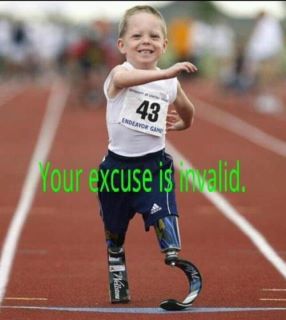
It’s time to get excited. As the poster by George Takei says, “Your excuse is invalid.”