What I Learned from Downton Abbey

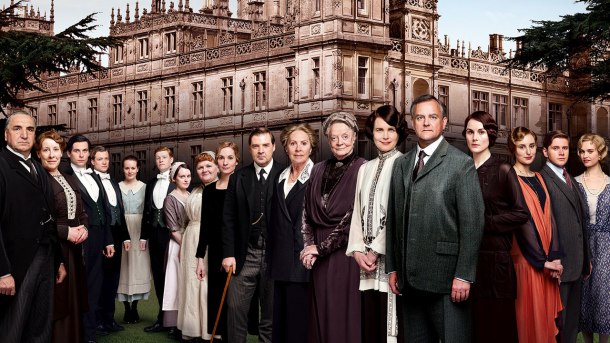
1280x720_downtonabbey_s4_cast


Six years is a good run. It’s also an investment in fictional lives, a milieu, and the often unnamed things that matter. Botch the story, send the characters off into self-absorbed whining, or worse, bore your audience, and they quit watching. Keep viewers who watch until the end and then look at each other with an expression of, “I-wish-there-were-more,” and you have done well as a writer. Downton Abbey, I believed passed the ultimate test of literature – a presentation close enough to life without actually mirroring it so that it speaks to us. A private world is created and we are allowed to live in it. We learn. We take something with us after the experience. This blog is about that something.

Lesson one: More than money, social position, or even the possession of near absolute power that can raise up the lowly or cause the downfall of the unfortunate – Kindness rules. (Take that, you politicians today who practice various scorched earth policies.) Kindness is the ultimate currency that buys life and influence; it is the power that eventually beats all others. It is in a lady’s concern for the progress of a village hospital. It is in a lord’s concern for the quality of housing built on an estate to help fund the Abbey. It is in a daughter’s willingness to swallow her triumphant pride and call back her sister’s estranged lover because it is best for her sister. It is in the pat of the hand of a dowager who tells the lady who has taken over her position as president of the hospital that she is doing a wonderful job. Kindness marks the lives of servants who worry about each other, save their own from suicide, risk their own positions to testify in court, keep secrets or not depending on what they think is best for the other person. It marks the generosity of an earl’s American wife and later, a newly-married husband who put their entire fortunes at the disposal of the family and the estate.

The greatest kindness is the vein that opens even in the prick of meanness. Because of it, the dog-stealer, the rebel, the scandalous, war’s wounded, and the petty autocrats are redeemed. Kindness heals; it makes the broken whole; it makes the savage human and the unsophisticated better than the aristocrat. When in doubt – be kind – always. At this point I am led to a greater passage – Portia’s speech on mercy from The Merchant of Venice, which many of us had to memorize (with good reading). “The quality of mercy is not strained. It droppeth as the gentle rain from heaven on the place beneath. It is twice blessed. It blesseth him that gives and him that takes….” Part of the lesson from Downton Abbey is that when the people are not kind, things do not go well, not for their rivals or themselves. The story of the under-butler Barrows is the best illustration. He almost died because of his own meanness and was saved only by the last-moment concern of a lady’s maid.

Lesson two: Nothing lasts. One would think that a house, an estate, a title chiseled into a culture and layers of traditions over many generations would ensure the continuance of those things, but it is not so. One of the interesting things is that Americans, we title-less, disorganized, anything-goes Colonials could be so fascinated by a class system we do not want, barely understand, and would certainly resent if it were imposed in the States. After all, we’ve developed our own class system based on money, which anyone can join if he or she has enough, no matter how that wealth was amassed. The Kennedys, the Rockefellers, the Gettys, and even the Walton family come to mind. What many did to get their fortunes may or may not have been legal; much certainly was unethical, but they did not get caught, or if caught, they found an oily way out. Fortunes are lost, not always by blunders, theft, or revolution. A fortune is lost because it is almost inevitable. It may take several generations, but it may also happen because a comma, a minuscule serif, is inserted in a piece of otherwise well-meaning legislation. Big Oil is a recent example, but there are others. Do you still own Sears stock? Enron? Bell Telephone? American Motors? Zenith Electronics? Even those that still exist are poor step-children today, sometimes the scullery maids who must get up first to clean out ashes and stoke the fires for others. Some ruined their own prospects; some fell to changing economic conditions, and some were simply swallowed up by predators.
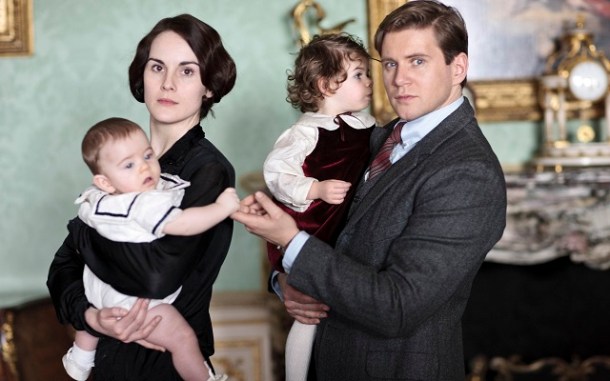
FIRST LOOK DOWNTON ABBEY SEREIS 4. Lady Mary played by Michelle Dockery with Baby George and Tom Branson played by Allen Leech with baby Sybbie COPYRIGHT: CARNIVAL/ITV

Even love may not last. It is interrupted by death, trouble, self-centeredness, pride, and faithless behavior. Love is a choice, and it must be re-chosen every day. We must tell our spouses. I choose you. I choose you. I choose you. Someone else may temporarily seem to be a better deal, but I choose you for the long term. Counselors tell us marriage is killed by disdain and the repeated eye roll. That means it is important we tell each other as often as possible: I choose you again. Designing maids may seduce lords. Ladies may be overly-appreciated by art historians. A visiting Turkish diplomat may die in a lady’s room. A chauffeur may marry a titled lady. We choose, and when we choose for the long term, things almost last. At least they last for long enough. At least they may last for a lifetime. What more could we ask?


Lesson three: No matter what our position, power, or personal integrity – we all just muddle though. In one of the most prescient titles of all time, Achebe’s novel Things Fall Apart reminds us all that Plan A is never enough. As Bobby Burns put it, “The best-laid schemes of mice an’ men gang aft a-gley.” In Downton Abbey we see the repeated near-bankruptcy of a privileged estate, a witness to other estates that failed, decayed, and became the mere ornament for the ultra-materialistic nouveaux-riches. Even the terms used to describe them are hyphenated.


images


In Downton Abbey, ovens break down the night of an extended family banquet; an old letter tossed into a fire nearly burns down the house; the joyful birth of a son is overshadowed by the death of the husband in a car crash, the same kind of accident that eventually sends Mary another husband. A child is born before Edith’s true love can marry her. An outsider, even worse, an Irish activist and mere chauffeur becomes the common-sense savior of the family estate. A bright, but naive daughter inherits a publishing company. A mere footman becomes an admired teacher who knows more than many graduates of Cambridge. All of this muddling, like struggles in any life, may seem impossible, but the older one gets, the more one has seen the impossible. A poor, black boy with an absent father becomes president. The presumptuously-named God-particle is found. A tiny wave in the time-space continuum is detected. Cancer cells may be “tagged” so one’s own immune system sees them as invaders and attack. Curiouser and curiouser. No one stays clean all the time. We rust. We sag. Our eyesight fades. Our memory gets more selective. It’s true of me, of you, of the famous, of the powerful, of the simple, of professors, of mothers who would give almost anything for a full night’s sleep, of fathers who don’t know where the next job will be, or the father who would give almost anything for a full night’s sleep, or the mother who doesn’t know where the next job will be. It’s all the same. We muddle through. We Muggle through. Magic may happen, but we have no wands.

The muddling makes us grow, and if it does not kill us, it makes us stronger. That is how LadyMary learns to run an estate; Lady Edith learns to edit a magazine; Molesley learns how to be a teacher, and Robert learns how to let go, possibly the most difficult lesson of all

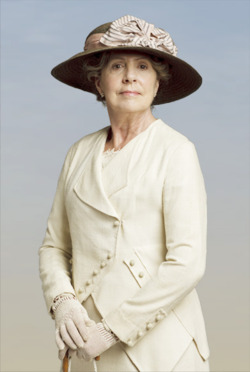
Lesson four: No one succeeds alone. It was fascinating to watch the Abbey work on a daily basis like a finely-calibrated watch. Not always, but usually. The clearly defined roles and coordination were amazing. Even more powerful was the handling of a crisis. A dead body was moved. Farms were run; sick pigs nursed; fires put out; deaths mourned; banquets prepared. It was done by people thrown together by circumstance, by choice, and sometimes by necessity. Even when some said, “No,” others stepped forward to offer support. If you want to help, but there is really nothing you can do, give empathy. Empathy heals as well or better than kindness and often better than misguided intention. The fast friendship of Lady Violet and Matthew’s mother Isobel Crawley was not cemented by kindred spirit or even similar interests. It was firmed and confirmed by empathy. Sometimes they merely sat with each other, listened, and “felt.”
tumblr_lolef1fsM71qaendxo4_250


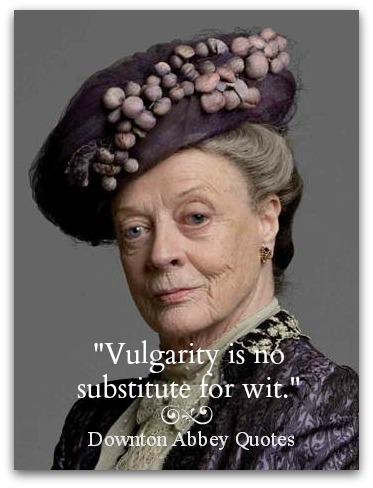
Lesson 5: Wit is always fun. My favorite character had to be Violet. At least she had the best lines, including several classics. “Weekend? What is a weekend?” About her friend Isobel in a tussle over the hospital. “Fight? Of course she’s allowed to fight. She’s just not allowed to win.” Even in her backhanded slaps, the harm is not so great from one somewhat physically feeble, someone still mentally sharp, and someone wearing a velvet glove. Comic relief is always important. I tried very hard to put it in my book, Hibernal, in the scenes with Porkchop andTrailer. It seems that some readers remember only that about the book. If they laughed out loud, as many readers reported, I am satisfied.
lady-violet-downton-abbey-quotes


All good things must end. Years ago I wrote a blog making fun of Downton Abbey, its excess, its confusing multiplicity of characters and emotional highs and lows. Somewhere along the line, I was won over, quite possibly because the reasonableness of its excesses, its interesting multiplicity of characters, and its emotional highs and lows. My disbelief certainly was suspended. If you win over a skeptic like me, you’ve done something, Julian Fellowes.


Peace

April 23, is generally regarded as Shakespeare’s most likely birthday, so it would be appropriate to begin with one of his quotations.

“Expectation is the root of all heartache.”

Some think he never said that, since scholars can’t find it in his plays, but that doesn’t matter if the plays were all written by Edward de Vere anyway. Who knows?

The complement to this is the title of the Dickens novel, Great Expectations. As I’ve written before, if something is true, I believe its complement is also true. I love paradoxes. As a retired teacher, I know the power of expectations in a classroom, where behavior and learning are so certainly a function of expectations. A teacher who expects little from his students will most certainly get it. It seems to me that in professional relationships, like those in teaching, which over time become personal, great expectations matter. That may be largely due to an unspoken statement akin to, “I have great confidence in you. You can do this difficult thing.”

Great expectations on a personal level, however, may be sure to bring disappointment. Wives and husbands could keep counselors employed for generations on this source of difficulty, never mind issues of debt, affairs, or addictions. I wonder how many times such sessions began with “I thought he was…” or “She should ….”, “Why doesn’t he …” or “If only she would ….” This doesn’t mean married people should have no expectations of each other. Common courtesy, loyalty, a willingness to help, a willingness to listen, a place of emotional safety, and shared long-term goals are things that matter. No marriage should be in trouble, though, because of the replacement of toilet paper, the position of a toilet seat, or a woman’s underthings drying on any available horizontal pole or doorknob. (I’m not saying my wife does this, mind you.)

Expectations are an intensity multiplier. Take the Super Bowl, for example. It’s still fun for me to watch a championship game played at the highest level, even if I’m not a fan of either team. I will always favor one side a little, but if my team loses, I’m not going to go out into the streets to overturn cars, set trash cans on fire, or break windows. If my team wins, I’m not going to go out into the streets to overturn cars, etc. If I really am a fan (short for “fanatic”) of a team, I may experience highs and lows that come from each individual play and range from extreme anger (that ref called WHAT?) to extreme elation, (Take THAT, in your face, you jerk!) Such extremes may be tolerable, perhaps even preferable for those who enjoy a sport, one of our substitutes for outright war, but I don’t recommend it as a way to live one’s life.

In the 60’s we youth (yes, there was such a time) used to tell each other, “Peace and love,” which kids of the 80’s turned into “Peace out.” It was the primary way many of us fought the Viet Nam war. There is something to be said for that attitude. Emotional highs and lows are not nearly as healthy as a whole series of little highs. If you don’t expect your wife to fill up the car with gas, but she does, what a nice present that is. If a husband isn’t expected to clean the bathroom, but he does, what a nice present that is. The point is that expectations always carry judgment, and it’s so much healthier to simply observe what is, rather than judge what ought to be but is not.

This is one of the primary ways in which a person lives a life in peace. Because I cannot control other people, games, the weather (ah yes, the weather lately), the timeliness of other people’s arrival, traffic, the news, politics, where birds deposit excretions, which direction the wind is blowing, or what someone just said to me, the solution is not rage, disappointment in expectations, or depression. To misquote Shakespeare or Edward de Vere, “All the world’s a TV show.” If you don’t like what you see, don’t throw the candy dish at the screen or yell at your kids, change the channel. Observe with interest, and if you don’t like what you see, look at something else. You have the TV clicker for your life. It’s in your pocket right now. Peace out, everyone.

In Praise of Old Things

I’m not old yet. There is something to be said for old things, though. I’m not just talking about twelve-year aged single malt scotch, although that smoky, thick taste has its appeal to some. Twinkies aside, not everything old is good: not ice cream that has acquired its own layer of permafrost, not sidewalks whose cracks, puddles and tectonic shifts are mere trips for anyone on wheels or twelve-year old scotch, not even old televisions with predictable channels and a familiar clicker with a volume button that sticks and the numeral 7 that doesn’t work at all. Old laptops, not good. Old cellphones with a battery life of half a phone call, not good. Old glasses, not good. Old textbooks, old maps, and old towels – not worth saving unless they begin a second life as a prop, background for a paper collage or a rag for washing cars.

There is something to be said for old things, though, almost anything that is cared for, sharpened, painted, oiled, or cleaned. Quite a list could be compiled: guitars, violins and pianos; jeans and boots, watches and jewelry, classic novels, and an occasional lawnmower. I am currently the proud owner of a 1940 Sears push mower inherited from Ann’s grandfather. It is easy to push, quiet, safer than my old runaway Toro, and perfect for the small yard we now have. It works, and as long as I keep it oiled and sharpened it hasn’t worn out its useful life. I especially appreciate the fact that it never kicks gravel and nut husks out a side vent at a hundred miles an hour toward one’s car. It will measure up any day to the previous four power mowers I’ve owned and used until they self-destructed in their teens.

A few old things deserve special attention, I believe.

My car, which I have dutifully serviced according to the schedule, now has 120,000 miles on it and runs like it was new. I need to fix a scratch in one door where a stump slid into me when I was out in the woods of the Upper Peninsula, but other than that, its four-wheel drive, four cylinder engine, sweet air conditioning, and purr when idling tell me there is no reason to replace it. Besides, it holds a lot of camping gear, fishing rods, and even a canoe on its rack with perfect ease. When I’m out on the streams, I distrust a fisherman who comes by in the latest Land Rover or Crossover. Until they’re broken in or earn some respect with a few dings, those cars are not suitable as fish-mobiles.

Our old house, a solid brick fortress build in 1925, has earned my respect. It was generally well cared for by its previous two owners who did a few curious things to it but kept as much original as possible. The hardwood floors are still smooth, well-grained, and mostly unscratched. After a cleaning, the fireplace works. The three-season porch is wonderful in the summer. The towering ash out front and the nearly as old pin oak out back are exactly the right height. (Please permit me a small joke.) Somehow our house came with the most wonderful neighbors who are already old friends, and we’ve only been in Madison two years. By comparison, our other houses, much newer and more modern, had basic flaws: cold downstairs, hot upstairs, a noisy furnace just below a master bedroom, air conditioning that could never be regulated well, and worst of all, they were in a neighboorhood where riding a bike was a death race; highway and air traffic from O’Hare fifteen miles away sounded like flame throwers had suddenly gone on sale. We could walk to Mosquito Park at the end of the block, and that was it. There were bike paths in Schaumburg, but you had to mount your bike on the back of your car and drive to them. Once you were on the forest preserve path you regularly received dirty looks when your passing interrupted drug deals. Our new old house is so much better. Yes, we replaced the wiring and kitchen and bathroom, and put in some air conditioning, but we had to do that in our newer old houses as well. An old house is like a favorite uncle. It has character and a happy story.

Old friends. Yes, they deserve special attention as well. There is something to be said for a group of people surviving twelve years with the same Catholic nuns as teachers, some of whom were the most inspirational masters possible, and others should have been tinsmiths or road graders. The latter were very good at cutting things up and bulldozing anything not perfectly flat. The former brought out what was good in us. That good survives. One of the interesting things about Facebook is that its re-connections remind us of who we are, and that hasn’t changed much. The brilliant ones are still brilliant. The kind ones are still kind. The smart alecks have softened a little but still follow the trajectory of kindergarten.

The actual number of years required for someone to become an old friend is variable, probably the same way time is flexible. Some friends you’ve known all your life, even though you just met them two years ago. When you reconnect with an old friend you haven’t seen in years, the time in between doesn’t matter, sometimes as if it never passed at all. Anyone who has gone through a divorce knows that relationships never end, not even when we want them to.

Old things remind us that we belong somewhere. The light switch you can find in the dark, the third fret on your guitar, middle C on your piano, the junk drawer in the kitchen where you know there will be the screwdriver or a rubber band you need – these are important old things. They also tell us something important about ourselves. In themselves, they mean nothing. A screwdriver is a screwdriver; a coffee mug is a coffee mug, but the tool or the coffee mug handed down from your father means something. We put that meaning into it. The mug is about us, I and my father, not about the coffee or the color or heft. As Shakespeare (or perhaps the Earl of Oxford, Edward de Vere?) wrote, it is thinking that makes a thing so. That is true of us, as well. We are what we think we are or, sadly for the weak among us, what we allow others to tell us we are.

I look forward to the day when I become an old thing in spite of the aches, health issues, and inevitable feeling that I have been left behind. I look forward to it because for someone else I will be the light switch she can reach in the dark, the coffee mug with just the right sized handle, the engine with 120,000 miles that still purrs, and the book of stories that are funny, interesting, sometimes sad and always readable. That book will be underlined throughout and annotated in the margins. It will have a happy ending.

Before that happens, I plan to visit the old things to remind them I’m still here: the pond at Konarcik Park outside Waterloo, the spring run at Montauk State Park with its gravel and watercress, Wrigley Field, Busch Stadium, Hubbard Street Diner with its chocolate-topped cheesecake, Disneyworld with grandchildren, Agate Falls in the Upper Peninsula. The list is too long and too personal. I think it should include trespassing at Camp Vandevanter west of Waterloo where we planted a whole hillside with pine seedlings when we were Boy Scouts. I’d like to see those trees, now that they are 50.

Even more fun will be to see the old things I haven’t met yet: Bleak House by Charles Dickens, some Agatha Christie I’ve missed, another season of Downton Abbey (yes the end of the last season was tragic, but no one loves only once), next year’s snows, another season of football at Camp Randall stadium with its raucous student section who always sing “Sweet Caroline” loud and a capella after the music stops and jump around after the third quarter. I can’t wait for the next Mumford and Sons album, their banjo, acoustic guitar, and base drum stomp reminding me that old-style music is still kicking. This is how it is, or as Ann says, whenever anyone asks her how’s she’s doing, “Good, mostly.” Old is good – mostly.

Busts, Death, Toilet Seats, Life, Irony, Apples, Stones, and Eden

So I’m sitting in the Arcadia Bookstore in Spring Green, Wisconsin, with my daughter, our keyboards clicking like self-running machines, and then I can’t write anymore. How do you write in a bookstore/lunchroom with a bust of Shakespeare on the top of a bookshelf staring down at you? I could quote him, I suppose, to get him off my back, but then he would just frown and say, “Plagiarism is not writing,” and I would answer, “You plagiarized everyone, including your friend Marlowe,” and he would answer, “Yes, but I did it so well, so much better than the original.”

As if I or anyone today could do that, even with the modern aid of high octane caffeine streaming through my veins like a torrent of contradictions from “To be or not to be…”

I don’t believe we can write if we’re trying to outdo someone, even if we’re only trying to outdo ourselves. Since I’m currently writing to entertain rather than inspire, I see that it’s time for a joke, or at least a modicum of irony. So I just went to the men’s room after a nut brown ale, some chili and a cup of coffee and found the ultimate women’s revenge, here in this bookstore/lunchroom run by women. It was a spotlessly clean men’s room, with a toilet lid that would not stay up. It’s one thing for them to complain about putting the seat down, but to go this far, to install a seat that will not stay up – that’s just too strategic, especially in a room women will not use. It seems like one of the women had a slightly too-large smile for me when I walked past the counter. The bust of Shakespeare is not amused.

Now I look past my dauighter and I see an ironic metaphor for our country – stacks of books with No Easy Day, the Navy SEAL’s account of the killing of Bin Laden, next to another volume entitled, The New Deal, a study of FDR’s plan to save the country. Death or life, which will you read?

Writing is “righting,” an attempt to make life better, or at least to shine a light on something wormy and so to make it shrivel and die. Writing is building something with words, a city or a life. The words are humble things, like the stones that become a cathedral. All life is metaphoric if one looks at it closely enough. It is so much more than the thing itself. An apple is more than an apple; it is a logo, a variable of gravity, a temptation that boots our parents out of Eden. An apple is more because our thinking makes it so. The apple does not matter. It could have been a walnut, a potato, or a plum. What matters is not the color, shape or taste, but rather, the fact that it fell and someone noticed it and saw there was meaning there.

Writing is that meaning, the moment someone picks up a stone, an apple, or a plum, studies it for a moment, and then smiles. “What?” says a friend, who is not a writer and does not hold the apple like truth-in-hand.

Will Shakespeare, you need not smile at me like that. I have held an apple in my hand and smiled at it when I saw that it was alive, teeming in its redness, redolent with sweet juice, firm as flesh, and holding in secret a truth we can hardly imagine. What is that secret? All things fall, and the falling is a beautiful thing to those who understand it. The falling makes an apple so much more than an apple. A fallen apple is one of us.

I am a writer. When you fall, I will bear witness. When I fall, someone else will witness. It is a beautiful thing.

Just for the record, I do not recommend taking too much caffeine in very good coffee after a bowl of white bean chili and a nut brown ale, even if Shakespeare smiles down upon it. It means that you will write about busts, toilet seats, life, death, apples, irony, stones and Eden. Yes, Will is definitely smiling at me.